
Although they never worked side by side in a conventional sense, the exchange of ideas between them produced some of the most intellectually provocative images of the twentieth century—images that challenge perception, logic, and the very structure of space.
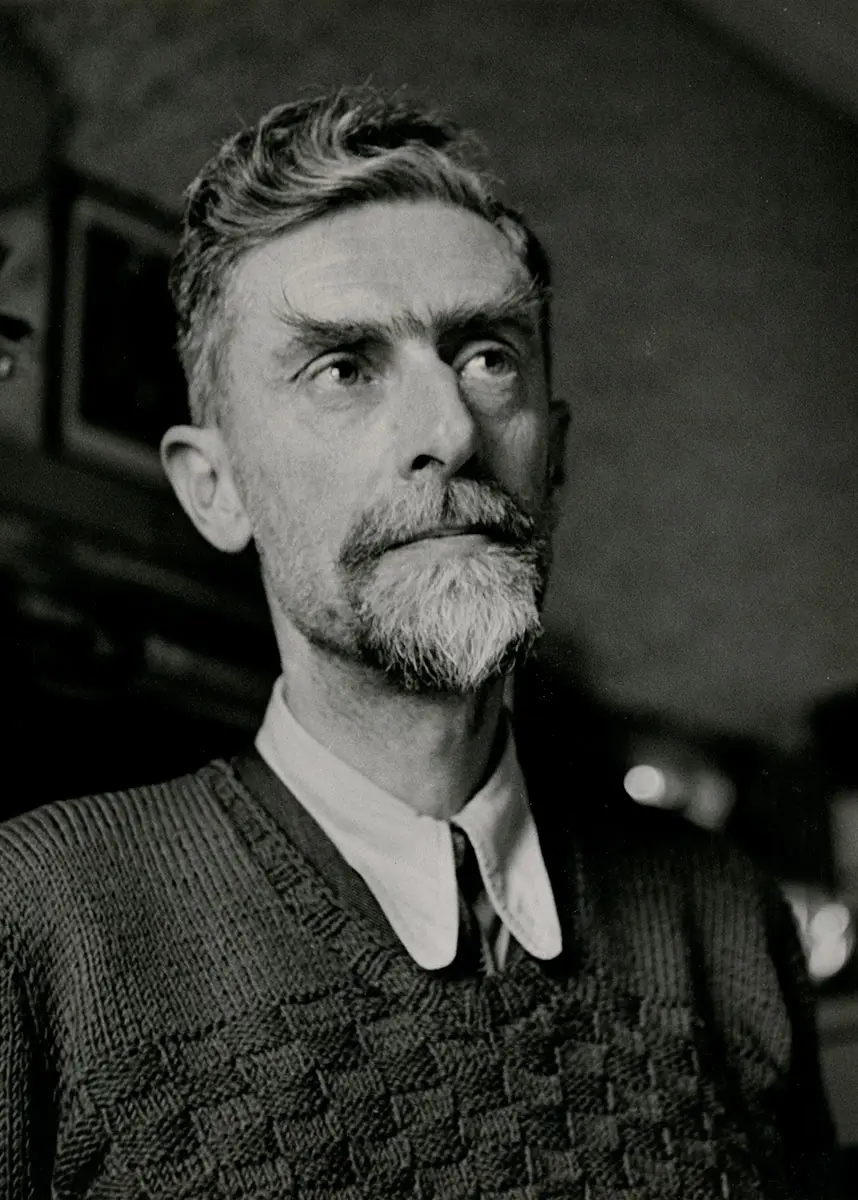
Escher, trained as a graphic artist rather than a mathematician, was deeply fascinated by tessellation, symmetry, and the manipulation of perspective. His work often explored impossible constructions—architectural forms that appear coherent locally but collapse under global scrutiny.
This fascination found a rigorous mathematical counterpart in Penrose’s work on impossible objects. In the 1950s, Penrose and his father, the geneticist Lionel Penrose, described the now-famous ‘Penrose triangle,’ an object that can be depicted in two dimensions yet cannot exist in three-dimensional Euclidean space.
Ascending and Descending
Escher encountered the Penroses’ work through a published article, and it provided him with a formal mathematical framework for ideas he had been intuitively exploring. The result was a series of prints that brought these abstract impossibilities vividly to life.
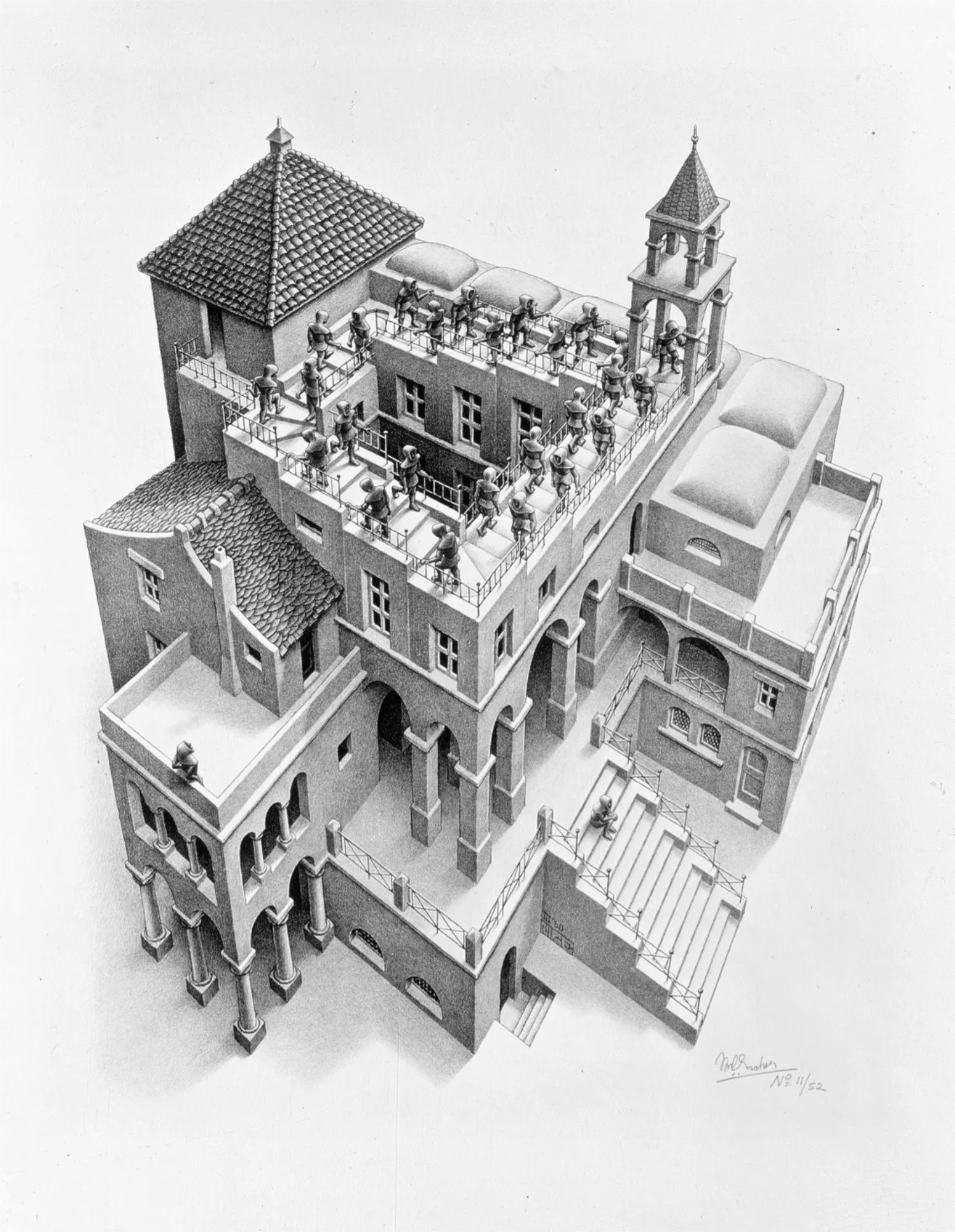
Among the most celebrated is Ascending and Descending, in which a procession of figures climbs an endless staircase. The structure is based on the Penrose staircase, a visual paradox in which a continuous upward or downward path loops back onto itself.
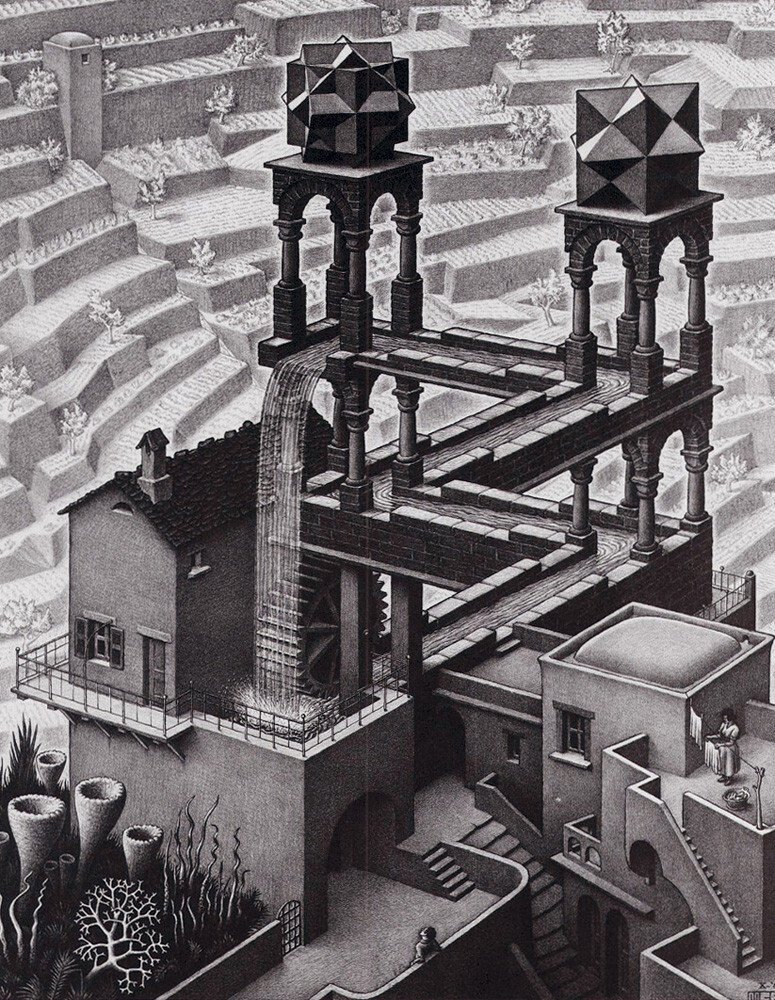
Another iconic work, Waterfall, depicts a perpetual motion machine driven by water that appears to flow uphill before cascading down again, violating basic physical laws while maintaining internal visual consistency.
Mathematical logic with artistic intuition
What distinguishes this exchange is not merely the borrowing of a clever idea, but the synthesis of mathematical logic with artistic intuition. Penrose’s constructions were abstract, typically rendered as line drawings to illustrate geometric paradoxes.
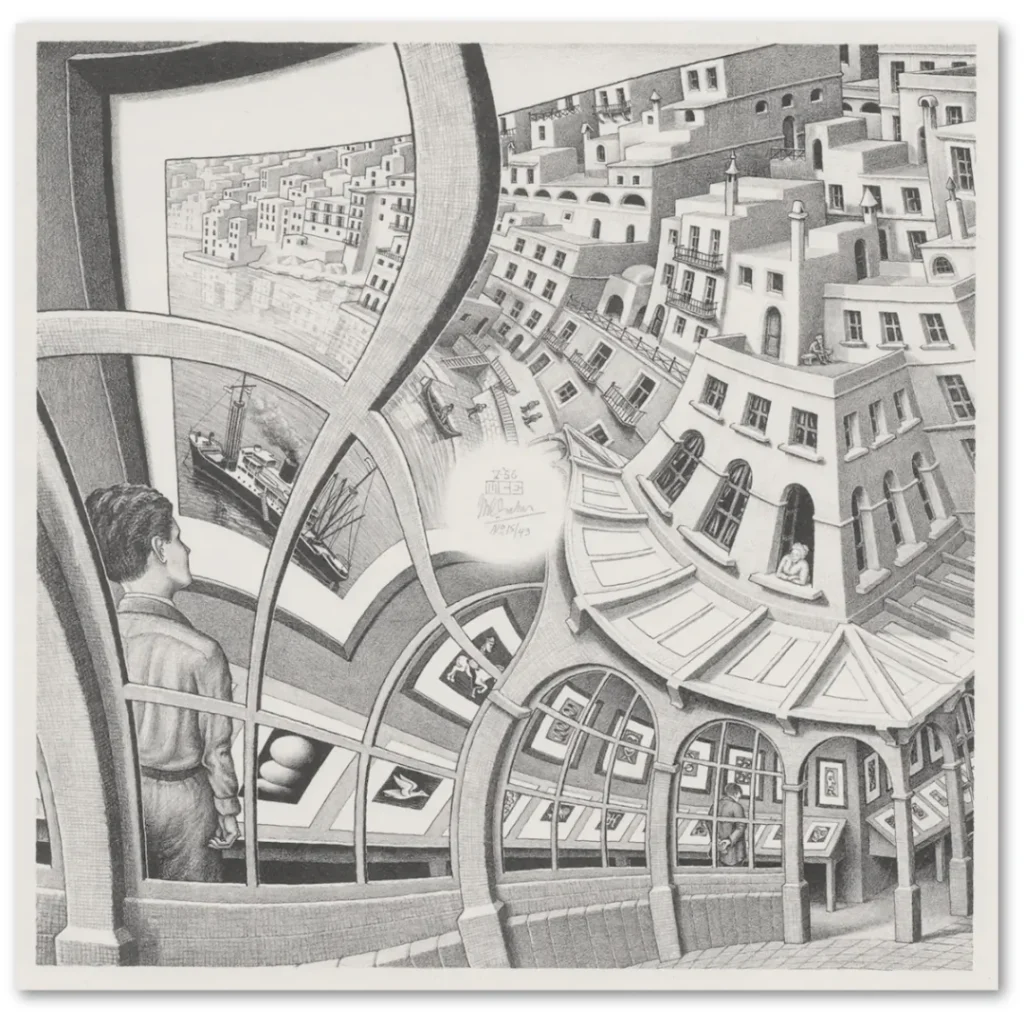
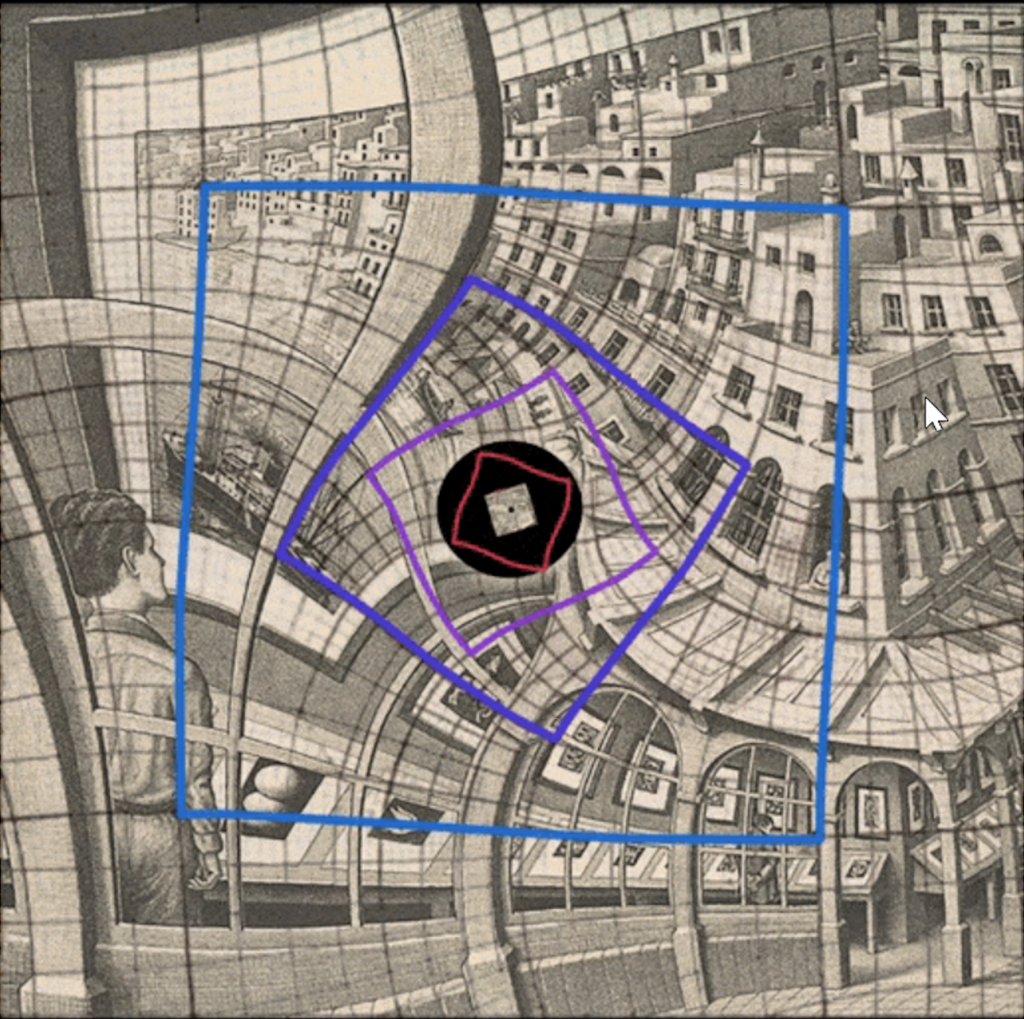
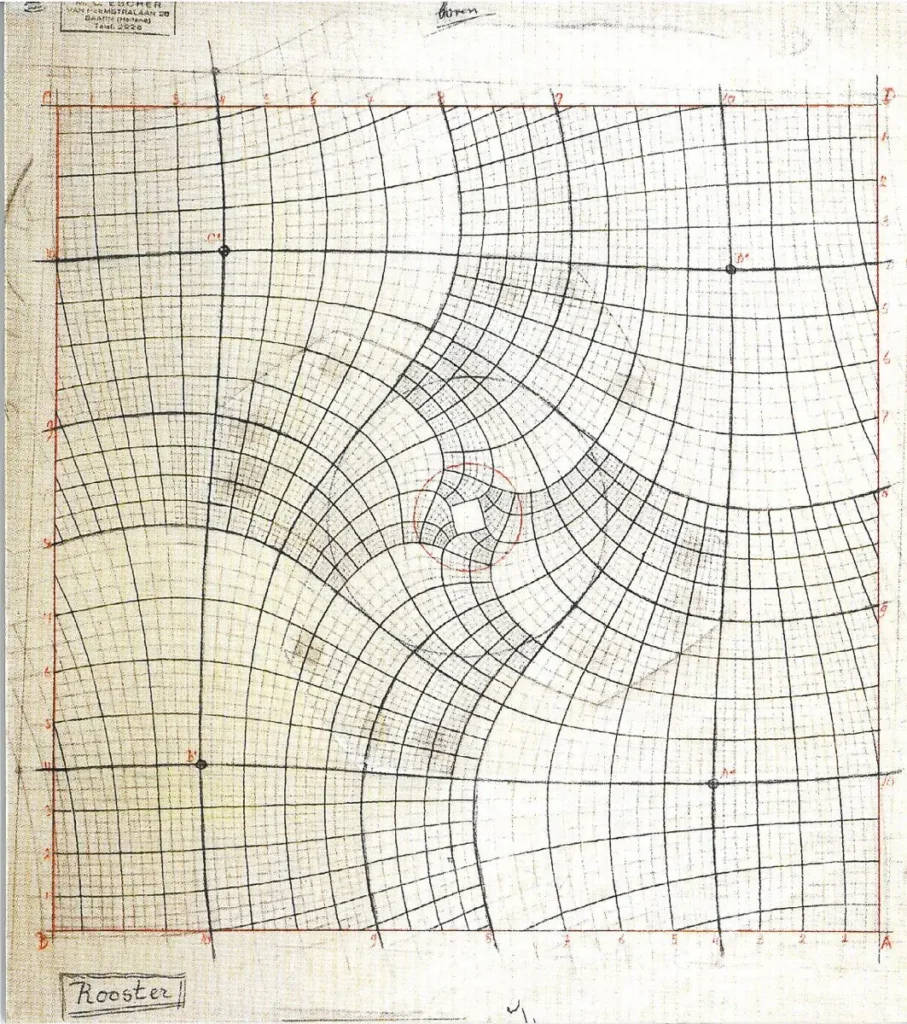
Escher, by contrast, embedded these structures within richly detailed worlds, complete with texture, narrative suggestion, and human figures. He transformed mathematical curiosities into experiential spaces—images that invite viewers to inhabit the paradox rather than simply observe it.
At the core of this collaboration lies a deeper mathematical theme: the tension between local and global consistency. In many of these works, each individual segment obeys the rules of perspective and geometry, yet the whole system is contradictory.
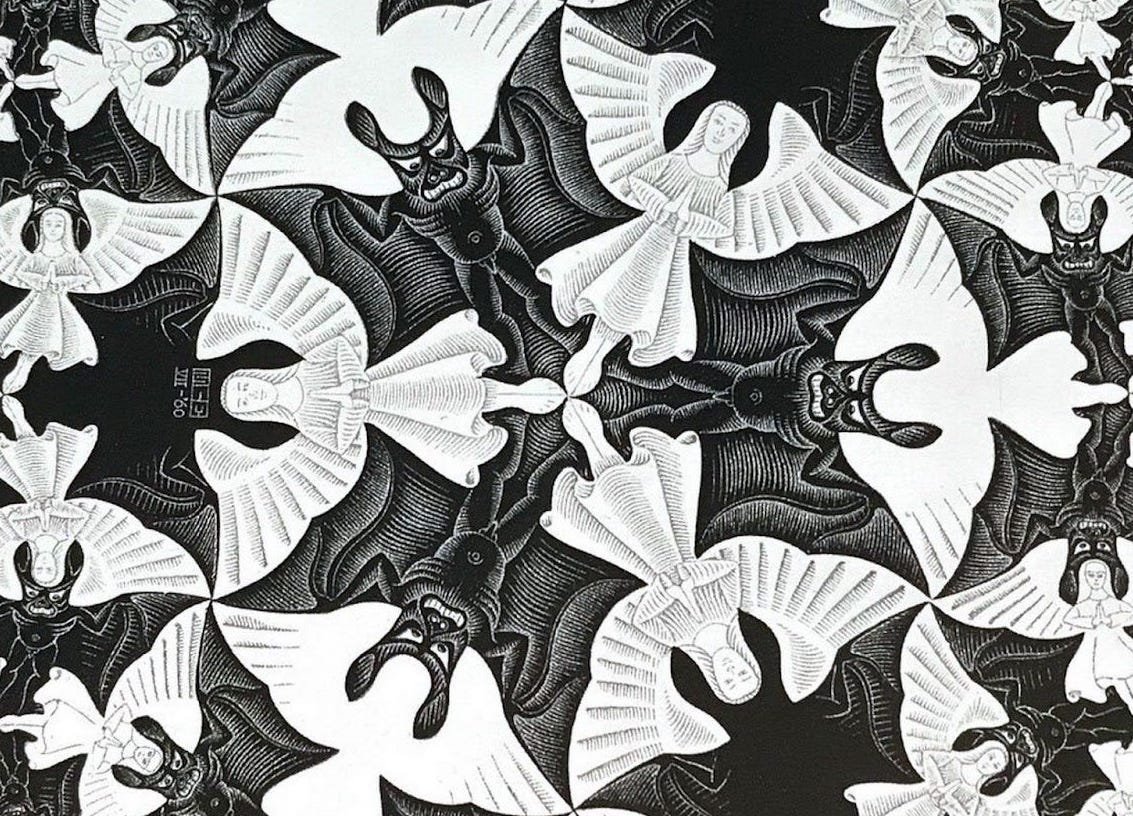
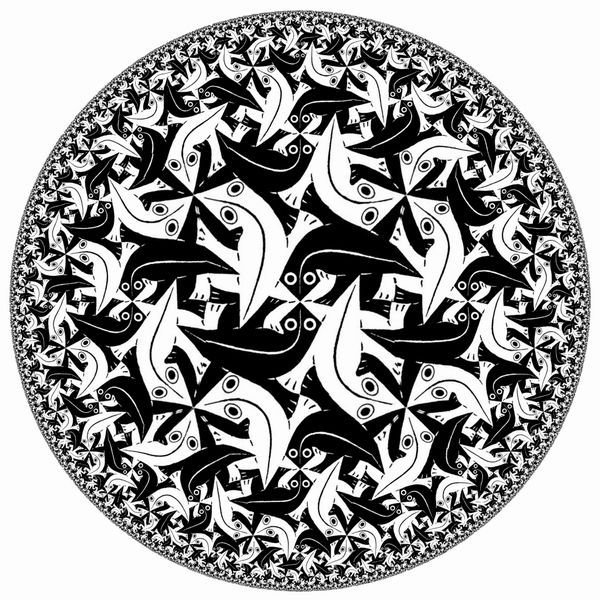
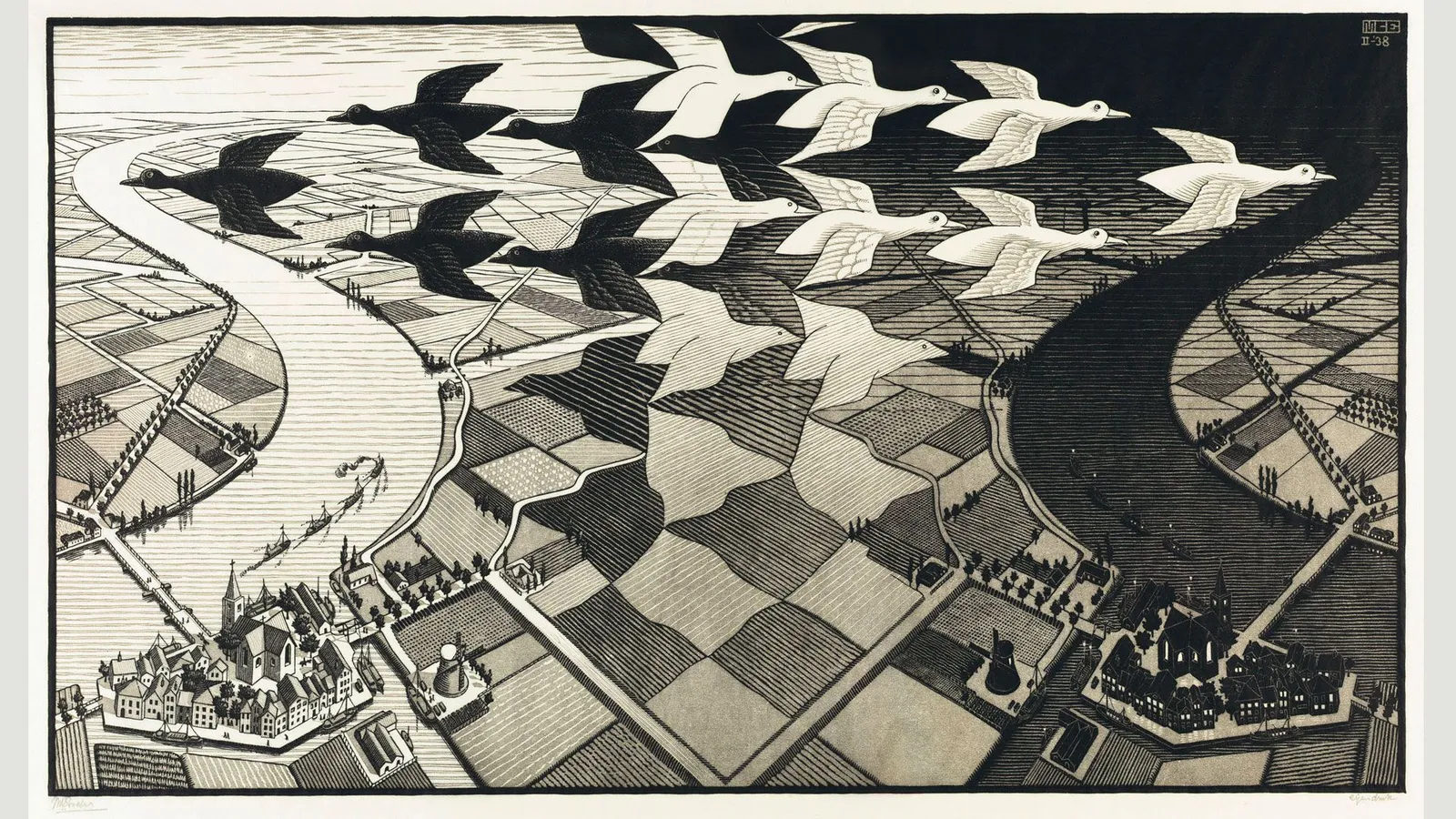
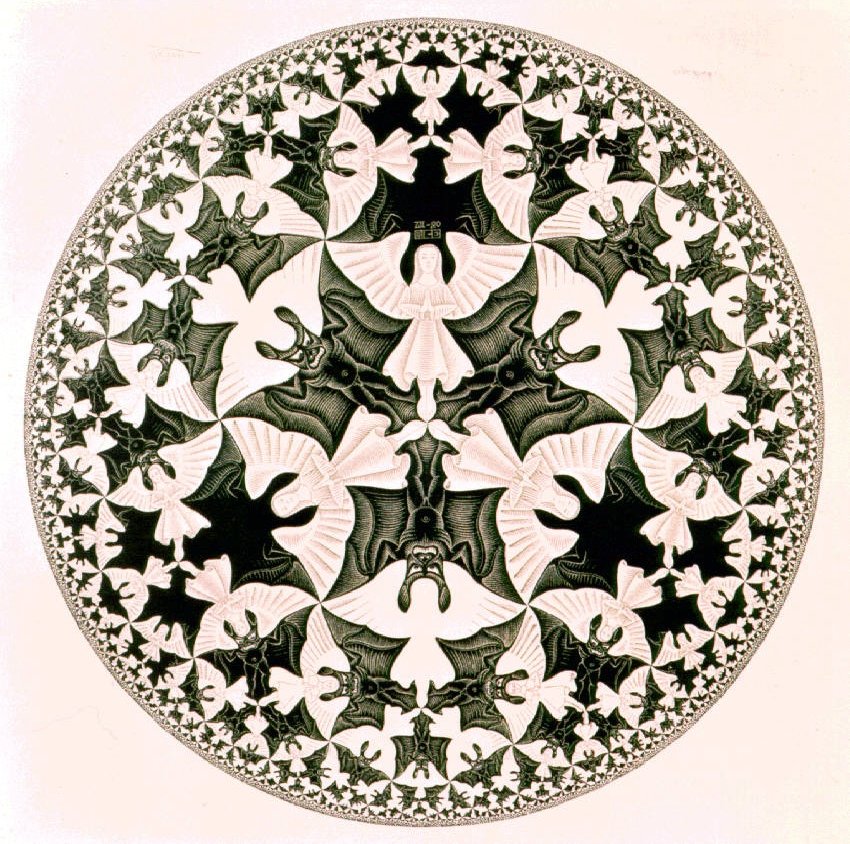
This aligns with broader concepts in topology and non-Euclidean geometry, where intuitive notions of space can break down. Escher’s prints thus function as visual analogues to mathematical proofs by contradiction, exposing the limits of perception. The influence of this interplay extends far beyond their immediate work.
Penrose would go on to explore aperiodic tilings—patterns that never repeat—while Escher’s explorations of symmetry and infinity continue to inspire mathematicians, artists, and computer scientists alike. Their connection exemplifies how disciplinary boundaries can dissolve, revealing that art and mathematics are not opposing modes of thought but complementary ways of understanding structure, pattern, and reality itself.
Leave a Reply