
Giro in tango is a move that is recognised by most beginners as an important move or a figure that people like to master. However one that probably will take a while to dance confidently and comfortably. It is a fairly common move in London milongas so it is worth to take your time to learn it.
Let’s first start with where the word comes from Giro in Spanish it means a turn. The expression used is ‘Hacer un giro’ – to make a turn. In tango ‘giro’ usually means to take a turn round one’s partner. The expression ‘giro pattern’ typically means these four steps: ‘Forward’, ‘Side’, ‘Back’, ‘Side’. So, that the follower travels around the leader in four even, equal, precise steps that form an even square/ diamond floor pattern around the leader; with the leader in the middle like the pattern of the ‘5’ side on a dice. The ‘Giro’, or journey round one’s partner can be started with any of these steps. However, once a giro is clearly indicated and led the follower will continue with the giro pattern until led to do something different. For example; speed up , slow down, stop, change direction.
We could describe the four steps of a clockwise giro pattern for a follower as follows : [Note that all of the movements are led by a clear invitation by the leader to move. The follower does not do any of this without being led. All the steps should be danced and pivoted from one into the other smoothly.]
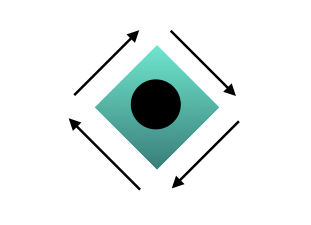
Forward step
The follower is invited to place their weight on the front of their left foot. They then are led to pivot their hips anticlockwise 45 degrees on the ball of their left foot. They are then led to step forward with their right foot around the leader, to their left (around his right side). The follower should try to step one quarter of the way round they leader. They should try to maintain the same distance from the leader, and not gradually move out and away from the leader ,or get closer, unless led to do so.
The idea of this is not complicated, but the precision of leading and following it well takes much practice. Once they have stepped clearly into the right place with their right foot, the follower then will transfer their weight on to that (right) foot. Then they bring their left foot neatly up to their right foot.
The follower ‘collects’ their feet together. They do not change weight, but keeps their weight all this time on the ball of their right foot. The follower is on an axis which runs vertically through their centre of gravity and their supporting foot. So, they can be pivoted clockwise or 180 degrees on that axis.
Side step
At the end of the forward step the follower has been led to collect, and is now pivoted so that they can take a side step with their left foot. As they take the side step; their hips, body and head should be facing their partner. As with the forward step, the side step must be around the leader, being careful not to get closer or further away. After the follower has transferred weight onto their left foot, they then collect, and is ready to pivot back clockwise.
Back Step
This is the hardest part, pivoting the follower back so that they can take an even back step that is equal in length to the other steps and continuing clockwise. The follower’s hips are almost expected to do a three-quarters turn or 270 degrees, but the pivot on the ball of their left foot is in fact only about 180 degrees if they have correctly stepped sideways on the ‘side’ step. So one of the things to check to make that ‘back’ step easier is to make sure the ‘side’ step is done properly, and the follower is not cheating by doing a sloppy mixed side/ diagonal/ forward step. In Giros diagonal steps are very rarely danced.
Side Step
At the end of the back step the follower has been led to collect, and should not need to pivot very much, so that they can take a side step with their left foot. As the follower takes the side step their hips, body and head should be facing their partner. As before, the side step must be around the leader, being careful not to get closer or further away. After the follower has transferred weight onto their left foot, they then collects, and can be ready to continue with the next forward step, or not.
Whilst the follower is dancing the forward, side, backward and side pattern, the leader has several options. They can shuffle or walk round on the spot in time with their partner whilst leading using counterrotation with the chest and facing their partner. Or there are endless Adorno’s or figures possible; commonly danced are the flecha, this means arrow in Spanish, or using Enrosques and saccades.
All these; Flechas, Enrosques and Saccades are moves that will be separately explained in other posts.