Controversy over Forza Nuova’s “March on Rome”

NOTE: This article was published on 9 September 2017Alfio Bernabei writes: In an unprecedented move Italy’s Forza Nuova has announced plans to march on Rome on 28 October, the same date as Mussolini’s march on Rome in 1922. Enthusiastic members of the organisation, described as Nazi-fascist by Italy’s Supreme Court, have flooded its Facebook page…

NOTE: This article was published on 9 September 2017

Alfio Bernabei writes:

In an unprecedented move Italy’s Forza Nuova has announced plans to march on Rome on 28 October, the same date as Mussolini’s march on Rome in 1922.
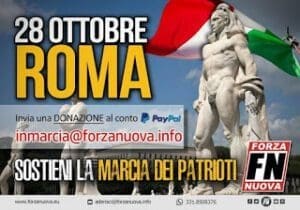
Enthusiastic members of the organisation, described as Nazi-fascist by Italy’s Supreme Court, have flooded its Facebook page with fascist slogans and offers of support in response to a call for donations from “fellow patriots” in order to fund the trucks, petrol, banners and flags needed for such an event.

While it is unlikely that local authorities will allow the march to go ahead, the announcement widely reported in the Italian Press still represents a further step in the organisation’s strategy to imitate the means by which fascism came to power in Italy 95 years ago.

By throwing such a high profile challenge to the authorities Forza Nuova clearly hopes to send a powerful signal of encouragement to other Nazi-fascist groups well beyond the Italian borders.

As well as in Italy the announcement appears in the Facebook Page of Forza Nuova newly formed branch in the United States.

Given Forza Nuova’s ambition to see itself as the lynchpin in international links with extreme right wing movements it would not be too far-fetched to think that by calling the proposed March on Rome “the March of Patriots” it intends to exploit the reverberations caused by recent events in America.

The former Ku Klux Klan leader David Duke spent a mysteriously long period in Northern Italy in 2011 and 2012 and little is known about his contacts there.

On hearing about the planned march the Rome Mayor, Virginia Raggi, tweeted “the #MarchOnRome cannot and must not be repeated” signalling her intention to prevent it from happening. Partito Democratico that leads the Centre-Left government coalition said the proposed event “risks turning into a tragic day for our country”. ANPI, the Association of Italian Partisans that keeps alive the memory of the Resistance against Nazi-fascism in WW2 intends to put pressure on the Government to intervene to stop the march.

Roberto Fiore, the ex-fugitive from justice who took refuge in London in the early 1980s and subsequently set up Forza Nuova described the planned march to protest “against an illegitimate government, to say “no” to proposed legislation that would give Italian-born children of migrants Italian citizenship and stop violence and rapes by the immigrants who have mobbed our country” as “a patriotic demonstration, not pro-fascist or nostalgic,” warning that the interior ministry would be wrong to ban the event.

Mussolini’s March on Rome on 28 October 1922 took place with the future dictator escorted by 25000 armed blackshirts, part of the squads which had terrorized the population in Central and Northern Italy burning the offices of parties and trade unions and killing opponents.


Paul Holborow

Paul Holborow

In the campaign against the National Front, Searchlight provided a rich and utterly reliable basis for much ANL propaganda – particularly with reference to the two leading NF figures, John Tyndall and Martin Webster. The appearance of Tyndall in full nazi uniform, drawn from the archives of Searchlight, was a key part of ANL propaganda, coupled with deeply damaging nazi quotes from Webster.

Paul Holborow
Founding member of the ANL and National Organiser 1977-81

Nick Davies

Nick Davies

To investigate fascists takes real courage and unusual commitment. The government, police, mainstream media occasionally take a look, but in the UK only Searchlight have kept at it, relentlessly and admirably, regardless of threat or obstacle. It’s journalism that matters. A rare thing.

Nick Davies
Multi-award-winning investigative journalist and writer

Professor Colin Holmes

Professor Colin Holmes
Everyone who wants to understand contemporary racism and its historical background needs to read Searchlight.
Professor Colin Holmes
University of Sheffield

Peter Hain

Peter Hain, founder of the ANL and friend of Searchlight

British Jews have been persecuted over the centuries; British blacks since the Windrush generation of the 1950s; British Muslims, especially after the Islamist 9/11 and then 7/7 terrorist attacks in New York 2001 and London 2005. But until the last few years there has not been a simultaneous threat against all three British communities of Jewish, Black and Muslim Britons – meaning the need for Searchlight has never been greater.

Peter Hain
Labour peer, former MP and Cabinet Minster

Alf Dubs

Lord Alf Dubs

Searchlight’s voice is more important than ever, and I am delighted that it will now be available to a wider audience than ever before in its new incarnation online. Searchlight has been extremely helpful over the years in exposing the far right, corruption, criminality and the murky links between organised crime and powerful interests in the UK and abroad. I wish Searchlight the very best.

Alf Dubs
Labour peer, former MP and Cabinet Minister, and Kindertransport child

Paul Nowak

Paul Nowak

The essence of trade unionism is solidarity, fairness and equality – for all workers – from all backgrounds. That’s why our fight against the far-right has always been part of our movement’s DNA. Searchlight is an incredibly important resource for trade unions and members to understand the contemporary tactics of far-right activity. Their work and intelligence gathering over the years have been incredibly insightful for the work we do, and how we fight the scourge of fascism.

Paul Nowak
TUC General Secretary

Top ten most read