Farage, Reform UK, and the Shadow of the Kremlin

NOTE: This article was published on 5 May 2025As Reform UK rides a surprising wave of electoral support across parts of England, the party’s populist rhetoric and its leader’s controversial foreign policy stances deserve renewed scrutiny. Nigel Farage, the face of Reform and the prime political figure synonymous with Brexit, has long portrayed himself as…

NOTE: This article was published on 5 May 2025
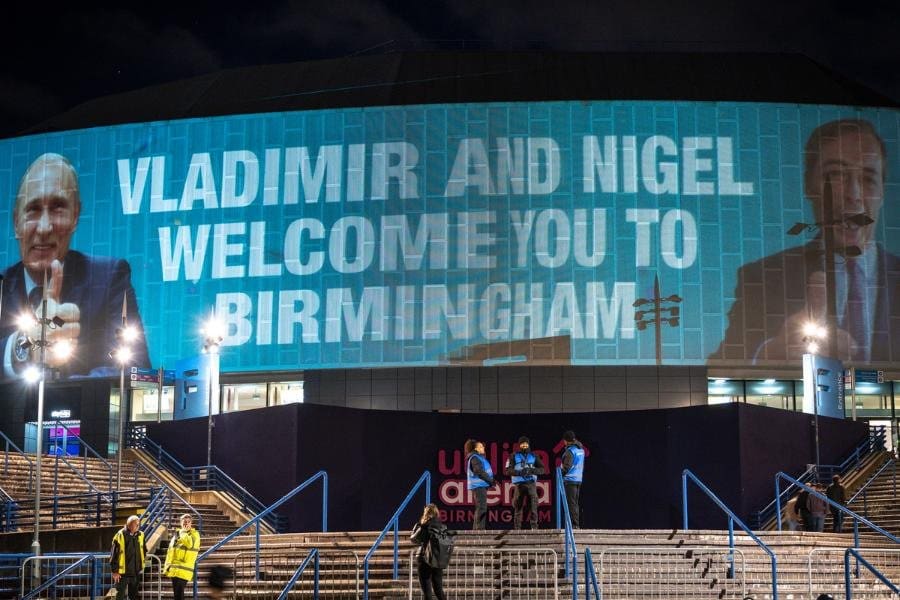
Led By Donkeys use giant screen at Birmingham Reform rally to draw attention to Farage’s affinity with Putin

As Reform UK rides a surprising wave of electoral support across parts of England, the party’s populist rhetoric and its leader’s controversial foreign policy stances deserve renewed scrutiny.

Nigel Farage, the face of Reform and the prime political figure synonymous with Brexit, has long portrayed himself as a crusader against establishment politics. But his pronouncements on Vladimir Putin and Russia suggest an affinity that goes beyond mere contrarianism.

Now, with Reform UK gaining ground, the implications are more serious than ever.

Kremlin talking points

Farage’s ambiguous stance on Russia is not new. In 2014, during a period of heightened tensions over Crimea, Farage stunned many by naming Putin as the world leader he most admired—not for his ethics or democracy, but as a political “operator” who, in Farage’s view, outplayed Western powers over Syria.

Though Farage qualified his remarks by condemning Putin’s record on press freedom and human rights, the comment signalled a preference for strongman tactics over liberal diplomacy. 

Since then, Farage has repeatedly echoed Kremlin talking points. Most notably, he argued that NATO and EU expansion “provoked” Russia’s invasion of Ukraine, a claim strongly condemned across the political spectrum. 

Keir Starmer went as far as accusing Reform UK of “fawning over Putin,” a damning charge in a geopolitical climate where solidarity with Ukraine remains a moral litmus test.

Parroting the Kremlin worldview

Farage’s critics also point to his appearances on RT (formerly Russia Today), a state-controlled network known for disinformation campaigns. Farage has dismissed such concerns as smears, insisting his views are grounded in realism.

Yet, as he courts disaffected voters with promises of national renewal, questions persist: why does he so often seem to parrot the Kremlin’s worldview.
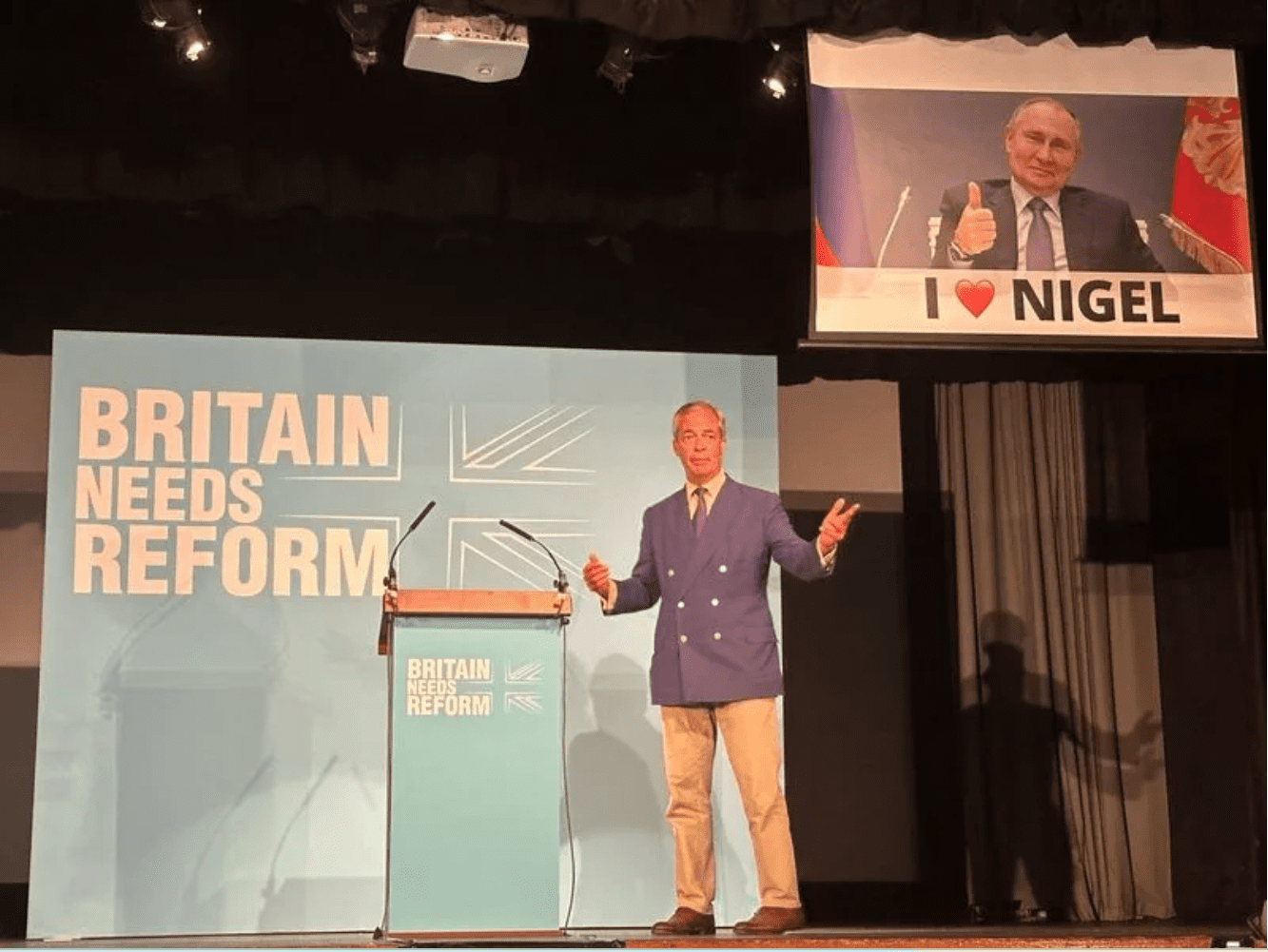
Led By Donkeys interrupt a Farage speech to make a point…

Further complicating the picture are Farage’s connections during the Trump era. In 2017, The Guardian revealed that Farage had been named a “person of interest” in the FBI’s Russia investigation—someone who was not suspected of criminal activity, but who might have had knowledge useful to the probe.

His public associations with figures like Trump ally Roger Stone and WikiLeaks founder Julian Assange have drawn media attention and speculation that Farage was closer to the transatlantic populist–authoritarian nexus than previously acknowledged.

Casting a long shadow

Although no hard evidence of wrongdoing has emerged, the pattern of associations, statements, and media appearances casts a long shadow. Reform UK may be the beneficiary of legitimate voter anger, but the geopolitical leanings of its leader merit concern.

Electoral success should not immunize Farage from scrutiny, especially when his positions appear to align more with Moscow than with Westminster.

As Reform UK aims for a breakthrough in the next general election, the British public must consider not just what the party stands against – but what, and who, it stands beside.


Alf Dubs

Lord Alf Dubs

Searchlight’s voice is more important than ever, and I am delighted that it will now be available to a wider audience than ever before in its new incarnation online. Searchlight has been extremely helpful over the years in exposing the far right, corruption, criminality and the murky links between organised crime and powerful interests in the UK and abroad. I wish Searchlight the very best.

Alf Dubs
Labour peer, former MP and Cabinet Minister, and Kindertransport child

Paul Nowak

Paul Nowak

The essence of trade unionism is solidarity, fairness and equality – for all workers – from all backgrounds. That’s why our fight against the far-right has always been part of our movement’s DNA. Searchlight is an incredibly important resource for trade unions and members to understand the contemporary tactics of far-right activity. Their work and intelligence gathering over the years have been incredibly insightful for the work we do, and how we fight the scourge of fascism.

Paul Nowak
TUC General Secretary

Peter Hain

Peter Hain, founder of the ANL and friend of Searchlight

British Jews have been persecuted over the centuries; British blacks since the Windrush generation of the 1950s; British Muslims, especially after the Islamist 9/11 and then 7/7 terrorist attacks in New York 2001 and London 2005. But until the last few years there has not been a simultaneous threat against all three British communities of Jewish, Black and Muslim Britons – meaning the need for Searchlight has never been greater.

Peter Hain
Labour peer, former MP and Cabinet Minster

Professor Colin Holmes

Professor Colin Holmes
Everyone who wants to understand contemporary racism and its historical background needs to read Searchlight.
Professor Colin Holmes
University of Sheffield

Paul Holborow

Paul Holborow

In the campaign against the National Front, Searchlight provided a rich and utterly reliable basis for much ANL propaganda – particularly with reference to the two leading NF figures, John Tyndall and Martin Webster. The appearance of Tyndall in full nazi uniform, drawn from the archives of Searchlight, was a key part of ANL propaganda, coupled with deeply damaging nazi quotes from Webster.

Paul Holborow
Founding member of the ANL and National Organiser 1977-81

Nick Davies

Nick Davies

To investigate fascists takes real courage and unusual commitment. The government, police, mainstream media occasionally take a look, but in the UK only Searchlight have kept at it, relentlessly and admirably, regardless of threat or obstacle. It’s journalism that matters. A rare thing.

Nick Davies
Multi-award-winning investigative journalist and writer

Top ten most read