
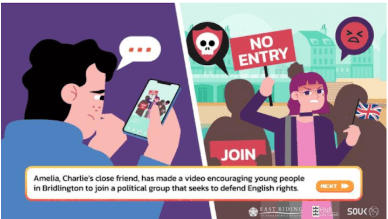
Amelia was never meant to be real. She began life as a cartoon character in a government-backed game designed to help young people recognise and resist extremist ideology.
But she has been reimagined online as something far darker: a far-right fantasy figure, fetishised, politicised, and repurposed by thousands of men who see in her both a mouthpiece for xenophobia and an object of desire.
Amelia first appeared in Pathways, a game designed to help young people identify and tackle extremist ideology. It was created by government programme Prevent, and featured six different scenarios involving radicalisation for users to navigate.
Imaginary girlfriend
The character Amelia is an anti-immigrant protester, who encourages her peers to join a group that ‘defends English rights’.
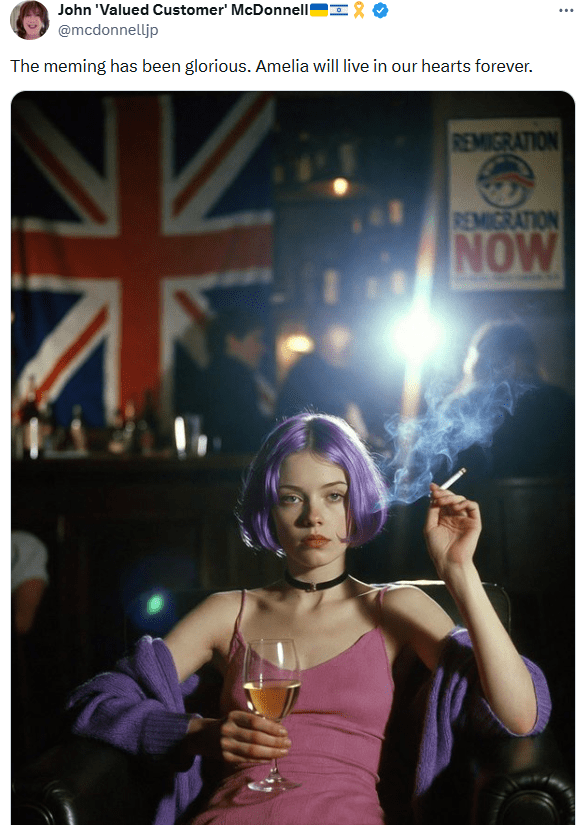
With her radical views and distinct dyed-purple hair, she has since become the imaginary girlfriend of the online far-right, with men openly fantasising about a non-existent, cartoon woman who shares their xenophobic views.
Despite dyed hair and gothic fashion having a long-standing association with left-wing politics, the far-right seem to be embracing Amelia’s alternative style.
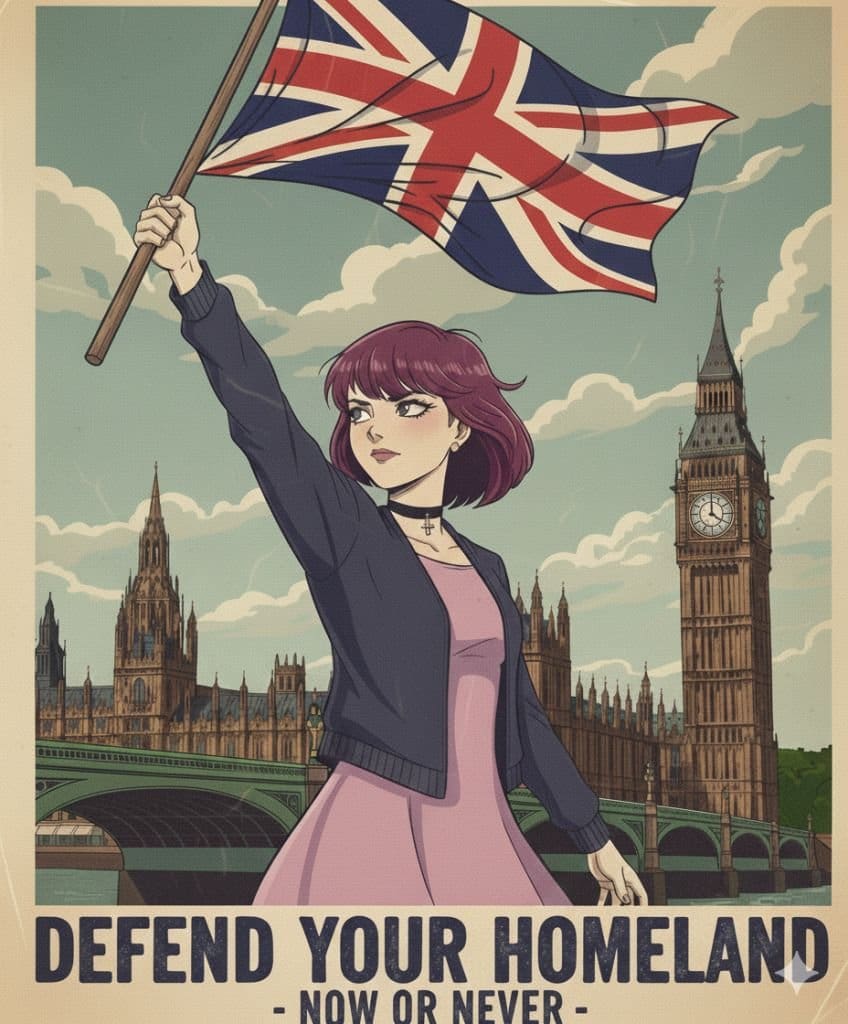
There are numerous edits of Amelia being spread on X – most of which appear to be AI-generated – which depict Amelia smoking, burning pictures of Keir Starmer, or waving the Union Jack outside Parliament.
Intersection
The obsession with Amelia exists at the intersection of misogyny and xenophobia, with men’s sexual fantasies blurring into their anti-immigrant stances.
In one notable video generated by Grok (X’s AI chatbot), Amelia shouts racist slurs, bemoans a lack of free speech in the UK, and claims Britain’s institutions are run by ‘a bunch of qu**rs and n*nces’.

It has been liked by over 60,000 users and viewed 3.6 million times.
Amelia addresses ‘English men’, telling them, ‘It’s your country and it’s being taken from you’ and to ‘get cracking, lads’.
This direct call to men demonstrates that the character is being used for two purposes: to incite racial hatred, and as a sexualised parasocial fantasy for the chronically online.
Grooming gangs
The video also refers to the grooming gang scandal in the UK; the horrendous misogynistic abuse that has been weaponised by the far-right to justify their Islamophobia.
Despite the sexism so often displayed by the online radical right (and the frequent overlap with ‘incel’ culture), many continue to pretend their vehement hatred of Muslim men comes from a desire to protect women.
Grok has explicitly engaged with the trend, calling on users to tag Reform UK leader Nigel Farage, political commentator Konstantin Kisin, and the far-right-adjacent podcast, The Lotus Eaters.
It suggests “they might have strong opinions on this Amelia vibe!” then proceeds to ask “What do you think, Brits?”
Elon Musk’s AI chatbot suggesting a British politician weigh in on a cartoon xenophobe is a bizarre example of his platform’s blatant political bias.
Musk has long fraternised with the far-right; he has endorsed Germany’s AfD, openly backed Tommy Robinson, including financially, and is regularly criticised for X’s algorithm, which peddles disinformation, partisan content, and AI imagery.
Triggering fear
AI is frequently used by the far-right in order to depict situations that haven’t happened, artificially triggering fear or nostalgia.
Germany’s AfD has used AI images of threatening ‘migrants’ in official campaign videos in order to push their nationalist agenda, as well as nostalgia-farming with an AI-generated ‘past Germany’.
However, official party content is just the tip of the iceberg. X and TikTok are swarming with AI imagery that is increasingly difficult to distinguish from reality.
The strange case of Amelia epitomises two issues: AI used to sexualise women, and AI used to normalise and propagate fascist ideology.
Pathways has since been taken down, but organisations dedicated to combatting extreme-right radicalisation must learn from this – that meme culture, AI, and lonely men are forces to be reckoned with.


