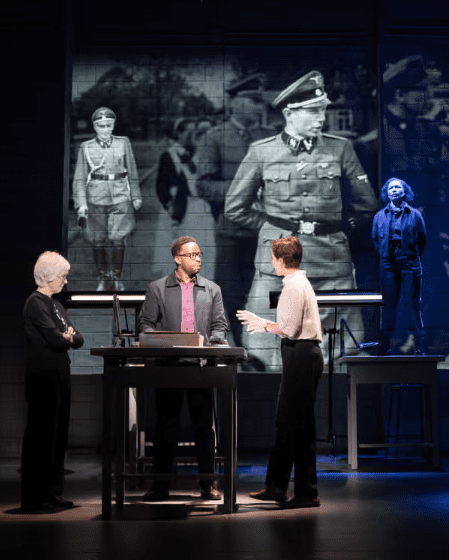
This extraordinary production at Stratford East lands with the quiet, cumulative force of a dossier being opened in front of you.
What emerges is not a conventional piece of Holocaust drama but an inquiry into how very ordinary people become functionaries of atrocity, and how institutions charged with memorialising victims must navigate the unsettling images of the perpetrators’ own self‑portraits.
It is a story that unfolds with the detached, procedural clarity of an archive room, fitting for a play whose central object is an 80‑page photo album documenting Auschwitz staff at leisure.
SS photo album
The narrative – a true story – begins in 2007, when the United States Holocaust Memorial Museum receives a parcel from a retired US lieutenant-colonel who, it later turns out, had worked for US Counter-Intelligence in Berlin after the war.
Awaiting accommodation, he had bedded down temporarily in a deserted apartment where he found a photo album. When he returned to America he took it with him.
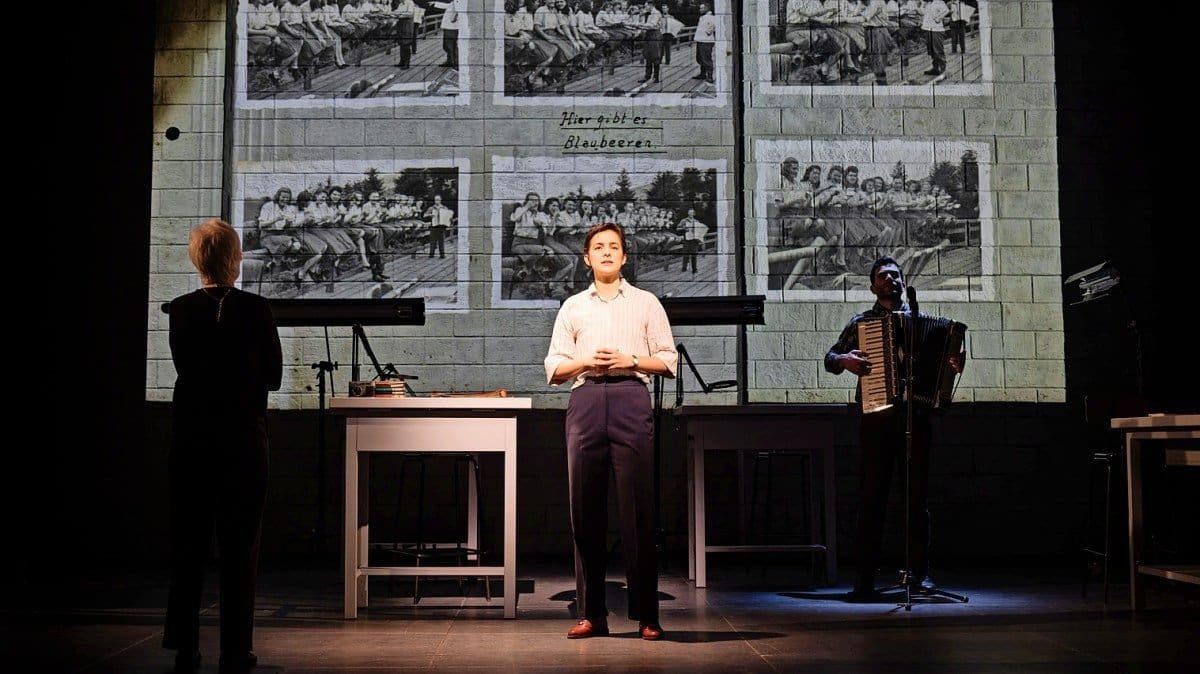
It becomes known as the Höcker Album: 116 photographs of SS officers and female clerical staff relaxing in the sun at a chalet, decorating a Christmas tree, sharing jokes, and eating blueberries.

The museum’s archivists, led in the play by Rebecca Erbelding (Philippine Velge) set about identifying the people in the images.
Their investigation gradually reveals that the album belonged to Karl-Friedrich Höcker, adjutant to Auschwitz commandant Richard Baer.
The photographs also provide the first visual confirmation of ‘Angel of Death’ Josef Mengele’s presence at the camp.
The plot moves between the museum’s present‑day inquiry, the wartime context of the images, and the testimonies of descendants and survivors. The structure is deliberately documentary: archivists speak directly to the audience, lay out evidence, and debate the ethics of interpretation.
The drama lies not in action but in the slow, methodical reconstruction of a world that the album shows only in fragments.
What gives the production its force is how closely it aligns with Hannah Arendt’s notion of “the banality of evil” a phrase which sprang to mind 15 minutes into the performance and refused to go away.
The photographs show no violence, no prisoners, no machinery of murder, only people who look “terrifyingly normal”, as one character notes.
Genocidal working day
The play’s power comes from this dissonance. The SS officers laugh in the rain; the Helferinnenkorps, the female communications and clerical branch of the Waffen‑SS, pose with bowls of blueberries; an accordion is played outside a hut. These are not images of monsters but of administrators, clerks, and adjutants who carried out genocide as part of a working day.
One of the most arresting moments comes with the enquiry into a particular photograph of a social gathering: SS officers assembled outdoors, apparently marking some minor workplace milestone with a sing-song. The photo is eventually dated to around July 1944.
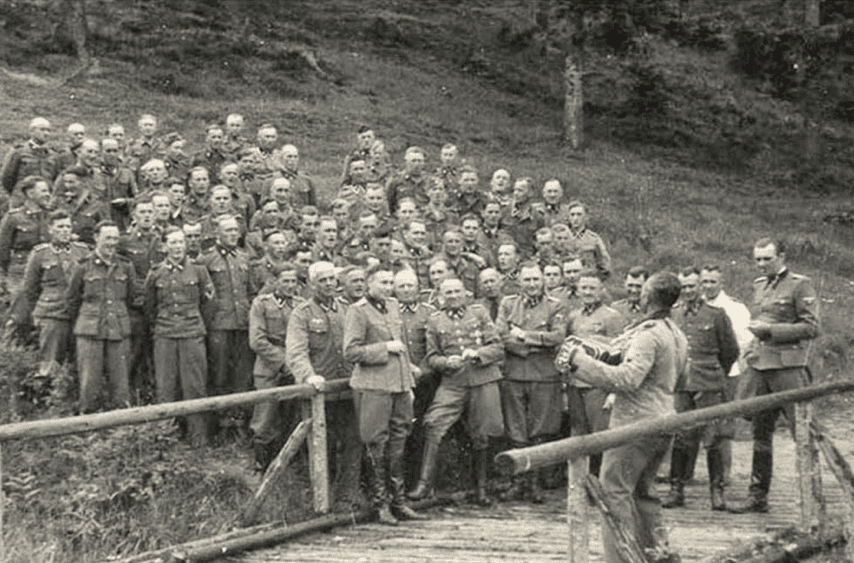
Then we learn what the celebration marks: between May and July 1944, hundreds of thousands of Jews from Hungary were being transported to Auschwitz, where they were killed.
This gathering marked the successful completion of the murder of 350,000 Hungarian Jews in just two months.
That is what these men were celebrating.
But did they know?
After the war, of course, came the denials: they were just clerical or administrative staff, not at all aware of the killing which was happening in a completely separate part of the complex. Could that be possible? Could that explain their relaxed, happy-go-lucky demeanour in so many of these pictures?
But then we hear the post-war testimony of one member of the Auschwitz Helferinnenkorps describing the records they would send back to Berlin after a trainload of prisoners had arrived at the camp and gone through ‘selection’:
“This many men, this many women capable of working, and this many men, this many women, and this many children, SB.”
“What does SB mean?”
“SB meant ‘Sonderbehandlung’, ‘special treatment’”.
“What does ‘special treatment’ mean?”
“‘Special treatment’ meant gassing”.
Running through the piece is a second, equally contemporary question: what should a museum dedicated to victims do with images of perpetrators? The United States Holocaust Memorial Museum was founded to document the suffering and destruction inflicted on Europe’s Jews.
Yet here it is confronted with a cheerful visual record created by those who facilitated that destruction.
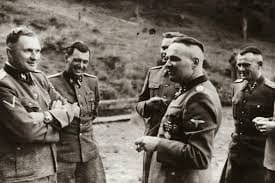
The archivists debate whether displaying the album risks humanising the perpetrators or, worse, shifting attention away from the victims who are absent from the story it tells.
At the same time, the museum recognises that the album is historically invaluable: it exposes the social world of the camp’s staff and the psychological distance they maintained from the unparalleled crimes occurring metres away.
The play treats this institutional dilemma with seriousness rather than polemic. It shows the museum wrestling with its responsibilities, trying to resolve the tension between remembrance and documentation.
Evil embedded
What this production offers is not a moral lecture but a study in how evil may become routine. The staging magnifies the photographs to monumental scale, forcing us into the same act of looking that so troubled the museum’s staff. Yet the more ordinary the images appear, the more disturbing they become.
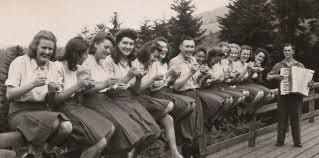
The result, marvellously written and performed, is a piece of theatre that functions like a long-form investigation which closes without fanfare, allowing the images to speak for themselves.
They portray another side of events which took place, in David Edgar’s memorable phrase, “in the heart of Europe, in the middle of the 20th century”.
Chilling
Chillingly, towards the end, one character, virtually alone amongst descendants of the perpetrators who wanted the album made public, recalls that:
“My grandfather confided in me once, and with a twinkle in his eye, he told me, ‘That was the best time of my life.’”
The images we are confronted with are banal, mundane, featuring the most ordinary of people. And they are all the more disturbing for precisely that.
Their calm surfaces and hidden histories stay with you long after, a reminder that the past is rarely as distant as we might wish.
Here There Are Blueberries, by Moisés Kaufman and Amanda Gronich, and created by Tectonic Theater Project, runs at the Theatre Royal Stratford East till 7 March. 


