The Supreme Court of Belarus has announced that it will begin criminal proceedings against Antanas Gecevičius, better known in Scotland as Antanas Gecas, for genocide. The case is scheduled to open on 18 March. The defendant has been dead for 25 years.
For anyone who followed Searchlight’s investigations in the late1980s into Nazi war criminals sheltering in Britain, the announcement will ring bells.
Suspect war criminal
Searchlight first identified Gecas as a war crimes suspect living in Newington, Edinburgh, in December 1986, when we looked into a Soviet press release that had been largely ignored by the British media.
What followed was one of the most sustained and consequential pieces of investigative journalism the magazine has ever undertaken.
Mass executions
Gecas was the commander of the third platoon of the second company of the 12th Lithuanian Police Auxiliary Battalion, a unit that participated in mass executions of Jews, partisans and communists across Lithuania and Belarus during the Nazi occupation.
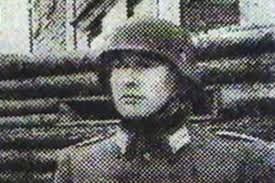
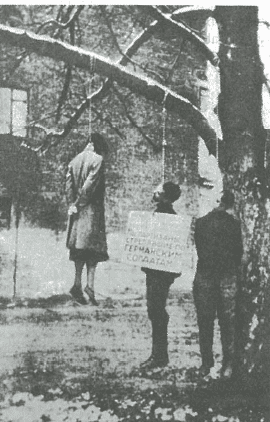
The killing was concentrated in the final months of 1941, much of it carried out in and around Minsk. Belarus now alleges that Gecevicius personally ordered and participated in the unlawful killing of at least 6,012 people, among them 31 children and numerous elderly victims.
His unit is believed to have been responsible for between 32,000 and 42,000 deaths in total.
Evaded capture
When the Red Army drove out the Nazi occupiers, Gecevičius fled westward with the retreating forces, changed his name, evaded Soviet capture, and eventually settled in Edinburgh in the early 1950s.
He worked as a mining engineer and ran a bed and breakfast. His neighbours had no idea.
Determined investigation
Searchlight’s exposure of Gecas’s crimes was not a lucky tip-off. It was the product of years of determined investigation.
In the summer of 1987, editor Gerry Gable and Sonia Gable spent ten days in the Soviet Union, the first British journalists to do so specifically to investigate war crimes, gathering testimony from survivors, prosecutors and witnesses in Moscow, Minsk, Vilnius and Riga.

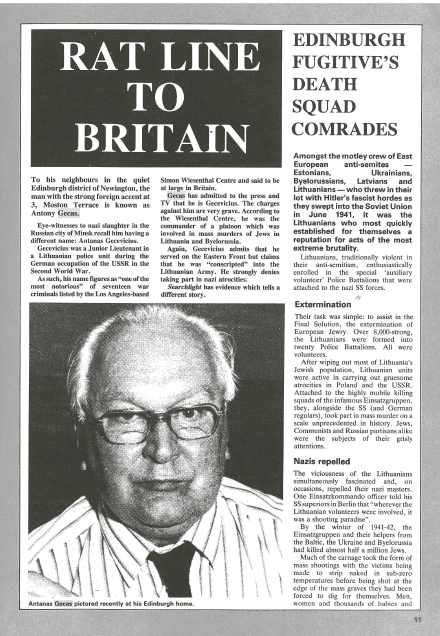

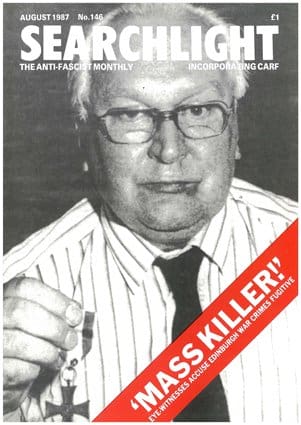
The August 1987 issue of the magazine carried the results under the front-page headline “Mass Killer!”, with Gecas’s photograph and eyewitness accounts placing him at massacre sites. You can read the full account of Searchlight’s war crimes campaign here.
That investigation fed directly into a national campaign, launched in October 1987 alongside the Union of Jewish Students and backed by trade unions, which lobbied Parliament and ultimately contributed to the passage of the War Crimes Act 1991, legislation enabling prosecutions for wartime atrocities committed abroad by people now living in Britain.
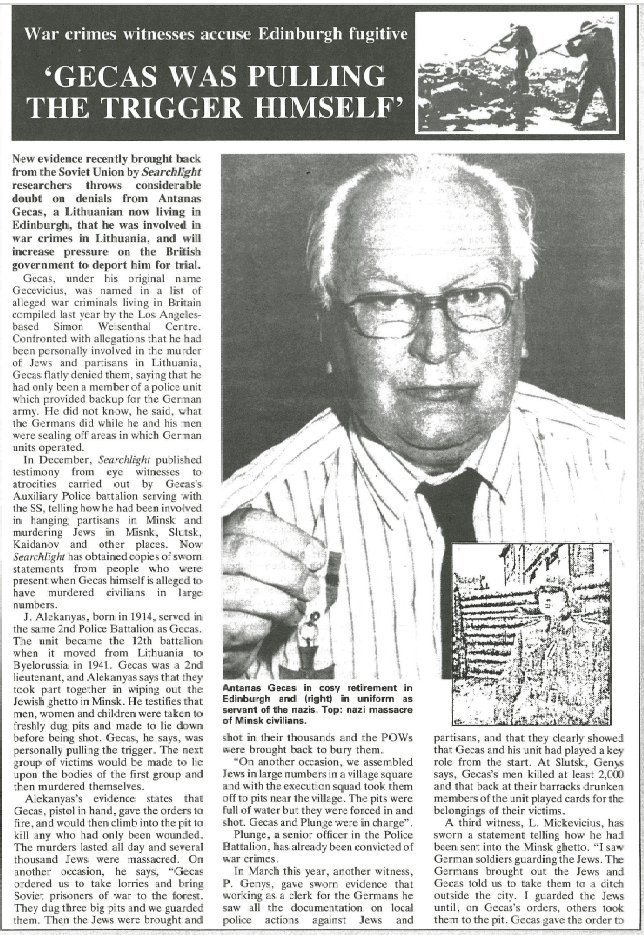
Despite a civil court finding in 1992 by Lord Milligan, sitting in the Court of Session, that Gecas had “committed war crimes”, criminal proceedings were agonisingly slow.
A warrant for his arrest was not issued until 2001. By then, Gecas had suffered two strokes.
The Scottish Executive, widely criticised at the time, declined to execute the warrant on medical grounds.
Gecas died at Liberton Hospital in Edinburgh just days later, aged 85, and without ever facing a criminal court.
The failure provoked outrage. Efraim Zuroff of the Simon Wiesenthal Center said that men who served as officers in the worst Nazi collaborator murder squads in Eastern Europe did not deserve to die unprosecuted in their beds.
Others pointed to the case of Feodor Fedorenko, a senior guard at the Treblinka death camp who was stripped of US citizenship, deported and executed in the Soviet Union in 1987, proof that political will had been the missing ingredient in Scotland.
Posthumous justice?
Belarus has pursued a series of such cases in recent years, and the criminal case against Gecečičius, running to 17 volumes and involving eight witnesses, is clearly a serious legal undertaking. A conviction would at least establish a formal historical record.
For Searchlight, the Belarus announcement is a grim reminder of what was lost through delay and political inertia. We identified Antanas Gecas nearly forty years ago. Evidence was assembled. A campaign was run. Parliament eventually acted.
And still he died in his bed, in Edinburgh, without ever being called to account in a criminal court.
The victims of his platoon, thousands of them murdered in the forests and streets of Minsk, deserved better than that.


