In April, eighty years ago, a British anti-fascist organisation was founded by Jewish ex-servicemen in the aftermath of the Second World War. It was called the 43 Group. Its origins lay in the anger of men and women who had fought and defeated fascism in Europe returning home to find it resurrected on the streets of London.
In the immediate post-war period, Britain’s fascists, again led by their pre-war fuhrer Oswald Mosley, sought to revive their movement, holding outdoor meetings on street corners around the city, often deliberately targeting areas with large Jewish populations.
Under attack again
London’s Jews came under attack once again, with many harassed by fascist gangs and Jewish-owned properties vandalised and wrecked.
The Association of Jewish Ex-Servicemen did oppose fascist activity, often setting up rival pitches at popular fascist locations, but the lack of physical confrontation from the association led to growing frustration.

In February 1946, four men, Morris Beckman, Gerry Flamberg, Alec Carson and Len Sherman, took matters into their own hands, approaching a meeting of the Mosleyite-controlled British League of Ex-Servicemen and Women and closing it down by force. It was the first time a fascist meeting had been physically shut down in post-war Britain.
Founding meeting
In April 1946, a group of 43 Jewish ex-military men and women, 38 men and 5 women, met at Maccabi House, a Jewish sports club, and formally constituted the 43 Group.
The Holocaust in the forefront of the minds of many of those present.
The group’s name derived from the number of people in the room at that founding meeting.

The 43 Group’s operational philosophy was crisp and unambiguous. Their credo of the “3 Ds” – Discuss, Decide and Do it – was quickly implemented on the streets of London, with hundreds of fascist meetings and rallies disrupted or closed down entirely.
Military discipline
Organised in wedges of a dozen or so, they would attend a fascist rally and, at a given signal, storm the speaker’s platform, attacking stewards and speaker alike. Their military backgrounds ensured tight discipline and clinically effective tactics.
Intelligence work was equally central to their operations. Members who could not take part in the physical side of the campaign were deployed as spies, infiltrating fascist groups and gathering information.
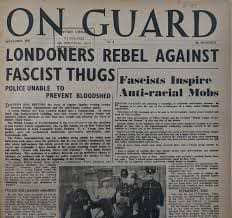
Their newspaper, On Guard, published between 1947 and 1949, regularly carried intelligence gathered by Group agents inside the fascist movement, as well as covering fascist activity internationally and racist injustices in the United States and South Africa.
By 1947, membership had grown to an estimated 1,000, including some non-Jewish members serving as infiltrators and spies.
Among the Group’s members was a young Vidal Sassoon, later to become the world-famous hairdresser but at the time a committed street fighter.
Ridley Road in Hackney became the symbolic battleground of the campaign, notorious for its weekly clashes between fascists and anti-fascists, the so-called Battle for Ridley Road.
Counter-productive
The 43 Group was viewed by established Jewish organisations, including the Board of Deputies of British Jews, as counter-productive. The Board worried that the Group’s activities could damage the Jewish community’s reputation, particularly given the militant Zionist campaign then being waged in British Mandate Palestine.
The state, meanwhile, offered no protection.

The Group was formally disbanded on 5 April 1950, having closed down roughly two-thirds of all organised fascist activity in Britain during its existence.
Its legacy proved durable. When Colin Jordan’s National Socialist Movement unfurled an enormous antisemitic banner in Trafalgar Square in 1962 and provoked a riot, former 43 Group members reconstituted themselves as the 62 Group in their predecessor’s image.
And it was members of the 62 Group who went on to set up Searchlight, in its first newspaper form, in 1965.
We are proud to stand in direct line of succession to these anti-fascist heroes.