
Ashlea Simon, co-leader of Britain First and partner of the organisation’s founder-leader Paul Golding, has announced via Telegram that she is leaving the party and will henceforth operate as an independent activist.
The announcement, uncharacteristically brief, offers no explanation for her departure. Given the history of Britain First, however, the circumstances are unlikely to be straightforward.
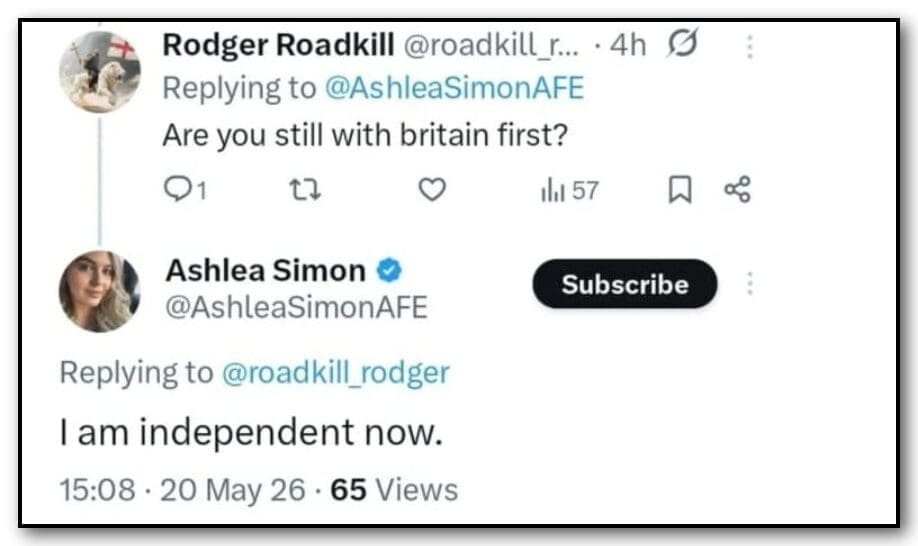
Simon has been the public face of Britain First’s electoral operation since joining in 2019, having previously cut her teeth in the Yellow Vests movement alongside James Goddard.
Rose through the ranks
Born and based in Salford in 1988, she rose rapidly through the ranks after Britain First finally achieved Electoral Commission registration in 2021, being appointed party chairman before being elevated to co-leader at the spring conference of 2024.

In that role she headed the political and electoral work while Golding concentrated on street activity, a division of labour that made her, on paper at least, the more electorally credible face of an organisation with very little electoral credibility to speak of.
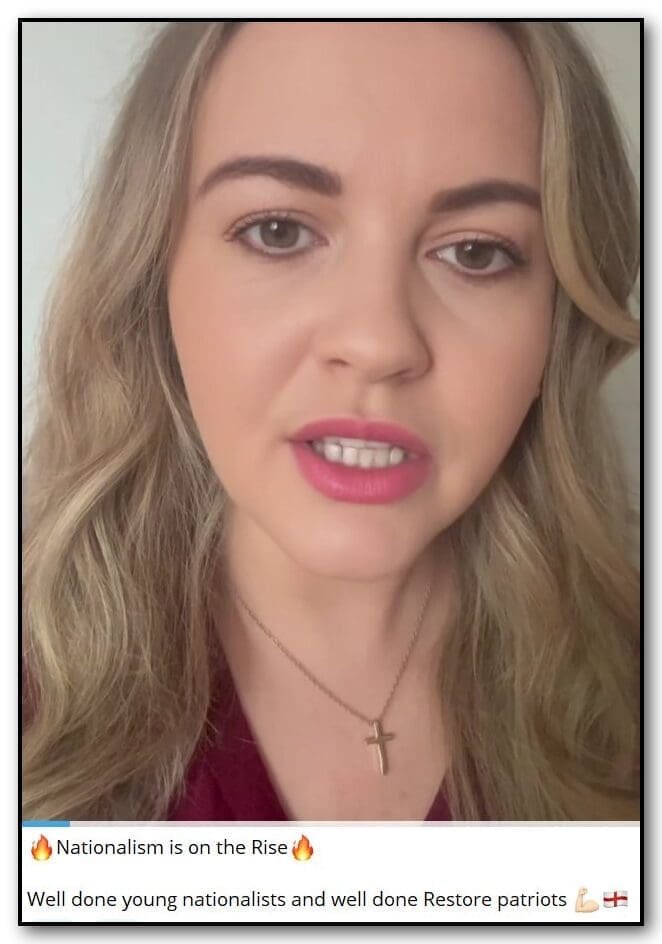
Her recent online activity offers some clues as to her next move. Complimentary references on Telegram to “Restore Patriots” suggest she may be moving towards the ethno-nationalist faction operating within Restore, led by Steve Laws and Sam Wilkes.
Significantly, she has also been posting that civic nationalism is dead and that ethno-nationalism is the only way forward.
Whether ideology accounts entirely for the split is another matter. The history of Britain First casts a long, dark shadow here.
Domestic violence
Golding’s previous deputy, Jayda Fransen, was also his romantic partner, and when that relationship collapsed it ended in acrimony: Fransen subsequently alleged that Golding had subjected her to physical violence on multiple occasions.

Those allegations caused significant damage to Golding’s reputation within the far right.
That Simon is both his co-leader and his current partner makes a clean, purely political separation inherently difficult to credit.
A personal falling out cannot be ruled out.

Golding, meanwhile, has been announcing what he describes as an organisational overhaul of Britain First.
Internal crisis
The timing is convenient. Such announcements have a familiar function on the far right, reframing internal crisis as strategic renewal, and disguising the loss of a key figure as a deliberate restructuring.
With a Britain First march scheduled in Birmingham on 20 June, Golding will be under pressure to demonstrate that the show can go on without his co-leader and partner alongside him.
Whether enough activists turn out to make that case convincingly remains to be seen.
Steady decline
Simon’s departure leaves Britain First in a weaker position than it has occupied for some time.
The party has been steadily declining in active membership and branch structure, with events increasingly staged for the benefit of donors rather than as genuine mobilisations. Golding’s financial security is an increasingly significant consideration: outside of Britain First he would be virtually unemployable.
But without its most electorally active candidate, Britain First’s claims to be a serious political force look thinner than ever.


