The voice they tried to erase: Maria Tănase and the Romanian Iron Guard

The Romanian Iron Guard tried to erase Maria Tănase’s recordings because of her Jewish associations. Instead, the country’s greatest singer survived fascism, dictatorship and censorship to become a national icon.

Maria Tanase
Maria Tanase – her recordings were destroyed

In 1940, as Romania’s fascist Iron Guard tightened its grip, some of its members entered a Bucharest radio archive and destroyed recordings by the singer Maria Tănase.

The official justification was petty: they claimed that Tănase’s interpretations of traditional songs “distorted Romanian folklore”.

The real objection was more revealing. Some of her closest collaborators and friends were Jewish, including the ethnomusicologist Harry Brauner, brother of surrealist painter Victor Brauner, and the journalist Ştefan Roll.

Jewish friends

To the Iron Guard, a Romanian cultural figure whose work was intertwined with Jewish intellectuals represented precisely the kind of society it wanted to eradicate.

They destroyed the recordings. They did not silence the singer.
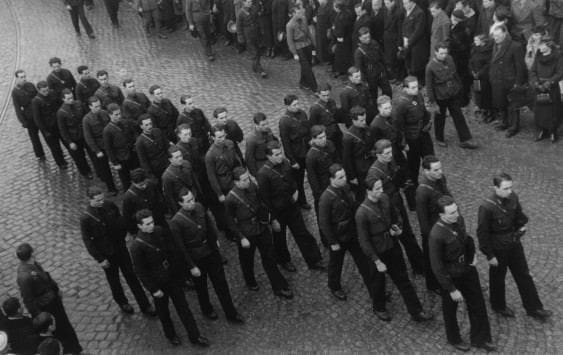
Romanian Iron Guard
The Romanian Iron Guard on parade in Bucharest

Born in 1913 in Cărămidarii de Jos, a poor working-class district on the outskirts of Bucharest, Tănase was the daughter of a florist and nurseryman.

The women who worked on her father’s land came from villages across Romania, and from them she absorbed the doinas, ballads and dance tunes that would become central to her distinctive style.

National star

She made her stage debut in 1934 at the Cărăbuş Theatre.

Four years later, radio recordings and an appearance at the Paris International Exposition transformed her into a national star.

Comparisons with Édith Piaf were inevitable: both women emerged from poverty to become defining voices of their countries.

Maria Tanase
Maria Tanase performs

But Tănase’s repertoire crossed boundaries that fascists were increasingly determined to police, combining Romanian folk traditions with tango, chanson and other influences.

By 1940, her fame and her associations had made her a target.

Refusal

It would be misleading to portray Tănase as an underground anti-fascist activist. She was not. Her story is instead one of resistance through refusal.

She did not abandon Jewish friends and collaborators to protect her career, even when the Iron Guard made clear the dangers of such associations. When her recordings were destroyed, she continued to perform.

During the Second World War, while Romania fought alongside Nazi Germany, Tănase toured with composer and violinist George Enescu, performing for wounded conscripts.

Maria Tanase sings for troops
Maria Tanase sings for wounded conscripts

Whatever the political circumstances surrounding those performances, she plainly saw them more as a humanitarian obligation beinging music and human dignity to people compelled to fight in a brutal war.

The Iron Guard’s political power collapsed in 1941, after its failed revolt against the regime of Ion Antonescu.

National treasure

Tănase survived it by more than two decades, continuing to perform through the war and the communist period that followed.

She died in 1963, already revered as a national treasure. In 2006, a public poll placed her among the 100 Greatest Romanians in history.

The recordings destroyed by the Iron Guard were never recovered. But while the fascists could destroy shellac and wax, they did not destroy the voice itself.


Paul Holborow

Paul Holborow
In the campaign against the National Front, Searchlight provided a rich and utterly reliable basis for much ANL propaganda – particularly with reference to the two leading NF figures, John Tyndall and Martin Webster. The appearance of Tyndall in full nazi uniform, drawn from the archives of Searchlight, was a key part of ANL propaganda, coupled with deeply damaging nazi quotes from Webster.
Paul Holborow
Founding member of the ANL and National Organiser 1977-81

Alf Dubs

Lord Alf Dubs
Searchlight’s voice is more important than ever, and I am delighted that it will now be available to a wider audience than ever before in its new incarnation online. Searchlight has been extremely helpful over the years in exposing the far right, corruption, criminality and the murky links between organised crime and powerful interests in the UK and abroad. I wish Searchlight the very best.
Alf Dubs
Labour peer, former MP and Cabinet Minister, and Kindertransport child

Paul Nowak

Paul Nowak
The essence of trade unionism is solidarity, fairness and equality – for all workers – from all backgrounds. That’s why our fight against the far-right has always been part of our movement’s DNA. Searchlight is an incredibly important resource for trade unions and members to understand the contemporary tactics of far-right activity. Their work and intelligence gathering over the years have been incredibly insightful for the work we do, and how we fight the scourge of fascism.
Paul Nowak
TUC General Secretary

Peter Hain

Peter Hain, founder of the ANL and friend of Searchlight
British Jews have been persecuted over the centuries; British blacks since the Windrush generation of the 1950s; British Muslims, especially after the Islamist 9/11 and then 7/7 terrorist attacks in New York 2001 and London 2005. But until the last few years there has not been a simultaneous threat against all three British communities of Jewish, Black and Muslim Britons – meaning the need for Searchlight has never been greater.
Peter Hain
Labour peer, former MP and Cabinet Minster

Professor Colin Holmes

Professor Colin Holmes
Everyone who wants to understand contemporary racism and its historical background needs to read Searchlight.
Professor Colin Holmes
University of Sheffield

Nick Davies

Nick Davies
To investigate fascists takes real courage and unusual commitment. The government, police, mainstream media occasionally take a look, but in the UK only Searchlight have kept at it, relentlessly and admirably, regardless of threat or obstacle. It’s journalism that matters. A rare thing.
Nick Davies
Multi-award-winning investigative journalist and writer

Today’s most read