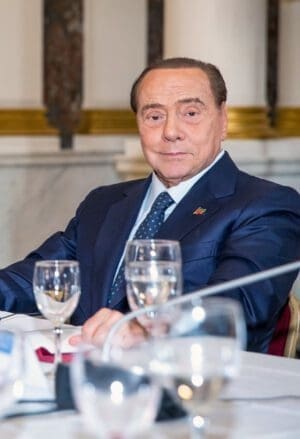
Silvio Berlusconi, 1936–2023 Photo: European People’s Party
Silvio Berlusconi helped rehabilitate fascism by falsifying the historical truth and lying about the crimes committed in the name of fascism. He did this by using a mixture of ignorance and persuasion, laced with seductive doses of panache and bonhomie amid plenty of televisual entertainment. Over the years, he made it possible for fascism to be considered a benign force and even a fashionable political design. This was his major political and cultural achievement.
The shift he brought about in the public’s perception of fascism and make it acceptable has led to the post-fascist government Italy has today. These grateful followers gave Berlusconi a state funeral, complete with live TV coverage and a national day of mourning. Helicopters flew over the fleet of cars accompanying his body for cremation, with cameras filming from all angles, provoking an epic surge of empathy on his passing. Thousands of people lined the route, eager to be part of the spectacle. It has been described as instant beatification.
Berlusconi signalled his intent to normalise fascism from the outset of his political career in 1994 when he became Prime Minister. As his allies in government he chose Gianfranco Fini, former secretary of the Italian fascist party Movimento Sociale Italiano (MSI), and Umberto Bossi of the Northern League, who was in the habit of treating people outside his beloved Northern Italy as an inferior race.
It seemed unlikely that this aberration would be tolerated by Italy’s strong left-wing body of opinion and its anti-fascist tradition for long. But Berlusconi knew better. In a highly significant move, he added to his team the dictator’s granddaughter Alessandra Mussolini, a former actress, glamour model and singer. He knew this political marriage would send a powerful message.
There were other significant and symbolic messages: among those employed at Berlusconi’s house was Vittorio Mangano, a Mafioso killer linked to the criminal organisation the Cosa Nostra. And there was little surprise when it became known that Berlusconi had been a member of the P2, the Masonic Lodge led by Licio Gelli that was part of the Gladio/Stay Behind organisation.
Berlusconi’s rehabilitation of fascism occurred, albeit tacitly, every time he appeared on television, which was not an infrequent occurrence, given he owned some of the channels. He was also an excellent communicator with the man and woman in the street: he never presented the issues with the complexity they deserved, but as perfectively solvable minor problems.
Over the years, Berlusconi served as prime minister three times: 1994 to 1995, 2001 to 2006 and 2008 to 2011. He managed to draw consensus not only from the electorate that had supported the defunct Christian Democratic Party that had dominated Italy since the Second World War, but also from Italians sympathetic to fascism, who had hitherto felt too scared to be seen to be openly associated with the MSI or other far-right movements.
Mussolini’s ‘good things’
Berlusconi started pointing to the ‘positive’ aspects of fascism as early as 1994: addressing his comments to the foreign press, he sidestepped any criticism from the Italian newspapers. Commenting on Fini’s description of Mussolini as ‘the greatest statesman of the country’, Berlusconi told The Washington Post that his ally was only ‘trying to be true to his party’s past’, adding: ‘Mussolini did some good things, and that’s something that history says is correct.’
In 2003, referring to the house arrest and incarceration of thousands of opponents to Mussolini’s regime on penal islands off the Italian coast, he told The Spectator magazine: ‘Mussolini sent people on holiday.’ In the same interview, he went as far as to say that ‘Mussolini never killed anyone’, as if to absolve the dictator of the killings perpetrated in the name of fascism.
Berlusconi never ceased to deliberately mislead, disinform and lie, saying, for example, that in Italy racial laws were introduced under pressure from the Germans, ignoring the fact that, from its inception, Italy’s fascism extolled the razza italiana.
The methods employed by Berlusconi have since been replicated globally to gain power, adapting his strategy to local expectations. Those who have drawn lessons from Berlusconi include Viktor Orbán in Hungary, Donald Trump in the USA, Jair Bolsonaro in Brazil and Boris Johnson in the UK. They may not be in the ranks of those calling for his beatification, but they certainly owe him a great deal as imitators.


