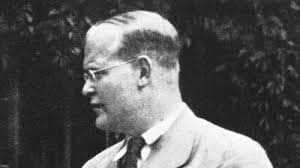
Today marks the 80th anniversary of the murder of Dietrich Bonhoeffer in the final days of the Second World war. The sounds of the bombardment of the advancing Soviet army showed defeat was near for the Nazis, but their priority was to kill internal enemies threatening them.
The killing of Bonhoeffer, a German theologian and ally of the resistance against Hitler, was an unforgivable act of pure vindictiveness.
Sustained opposition
Bonhoeffer’s murder was the product of his sustained opposition to the Nazis from the coming to power of the regime in 1933 to his arrest on 5 April 1943. The arrest followed a period in the war when he had sought contacts with the British via the underground resistance.
This led to him having contacts with the Abwehr – the German military intelligence – who used him to contact the British government because of his pre-war work in England. He was imprisoned in the Tegel jail initially until moved to the Flossenburg concentration camp.
Working underground
By spring 1945 he was regarded as such a threat that the regime killed him. Undoubtedly, he had worked in England in the 1930s and had contacts abroad. Yet Bonhoeffer practiced non-violent resistance – in 1935 he had been given the chance to study non-violence with Mahatma Ghandi in his ashram, but he chose to return to Germany despite Nazi control.
Even in the totalitarian state of Germany under the Nazis some Germans resisted Hitler and worked underground, with Bonhoeffer prominent, working to preserve a non-nazi current in German Christian circles. This did not prevent his arrest at the height of the war though his non-violent beliefs had protected him till then from police action.
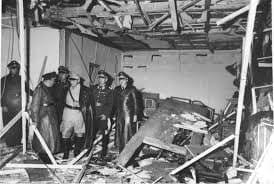
When he was arrested the Nazis had difficulty in claiming he was involved in violence against the regime, but attempts were made to link him with the 1944 officers plot to kill Hitler, code named VALKYRIE, though he was in prison when a German officer, Van Stauffenberg, tried to kill Hitler by planting a bomb at his HQ on 20 July.
The killing of Bonhoeffer, a German theologian and ally of the resistance against Hitler, was an unforgivable act of pure vindictiveness.
There was still no evidence to justify his execution till, on 4 April, the diaries of Admiral Canaris, head of the Abwehr, were discovered during an investigation into disloyalty within the intelligence services. Canaris had been sent to Flossenberg along with other prominent anti-nazi figures, including Bonhoeffer, suspected of plotting against the regime.
The diaries suggested he was one of the contacts with the British. Hitler ordered leading anti-nazi figures imprisoned in Flossenburg to be murdered, and one of these was Bonhoeffer.
On 8 April 1945 Bonhoeffer was tried by kangaroo court despite the audible sounds of the bombardment of the advancing Soviet army in the distance. The trial proceeded without evidence against him, and without him being allowed defense counsel. No records were kept, and the judge was an SS officer.
Hung till dead
The outcome was inevitable and the following day Bonhoeffer was stripped naked and hung till dead along with Canaris and members of the anti-nazi resistance.
Some accounts record a swift death, others that the execution took some six hours and included the mediaeval practice of hanging and drawing – used in Tudor England but long since abandoned in Britain – of hanging till consciousness was lost, followed by an attempt at reviving the unconscious victim, then hanging again, repeated till reviving was not possible and only a corpse remained.
The corpse of Bonhoeffer was never found in the chaos of the final months of the Third Reich, and he was never given a proper burial.

Anti-nazi martyr
Bonhoeffer’s reputation is primarily of an anti-nazi martyr representing the best of those post-Lutheran churches who stood against the nazification of German Christianity.
Sadly, most Christians succumbed to the appeal of the Nazis, making those who resisted more valuable. In England, where he had worked as a priest in the 1930s, he is often remembered as a theologian, but his resistance to Nazism is more widely recognised. His statue has been added to the exterior of Westminster Abbey in a remodelling adding new statues of Christian martyrs.
The 80th anniversary of his murder should be widely commemorate


