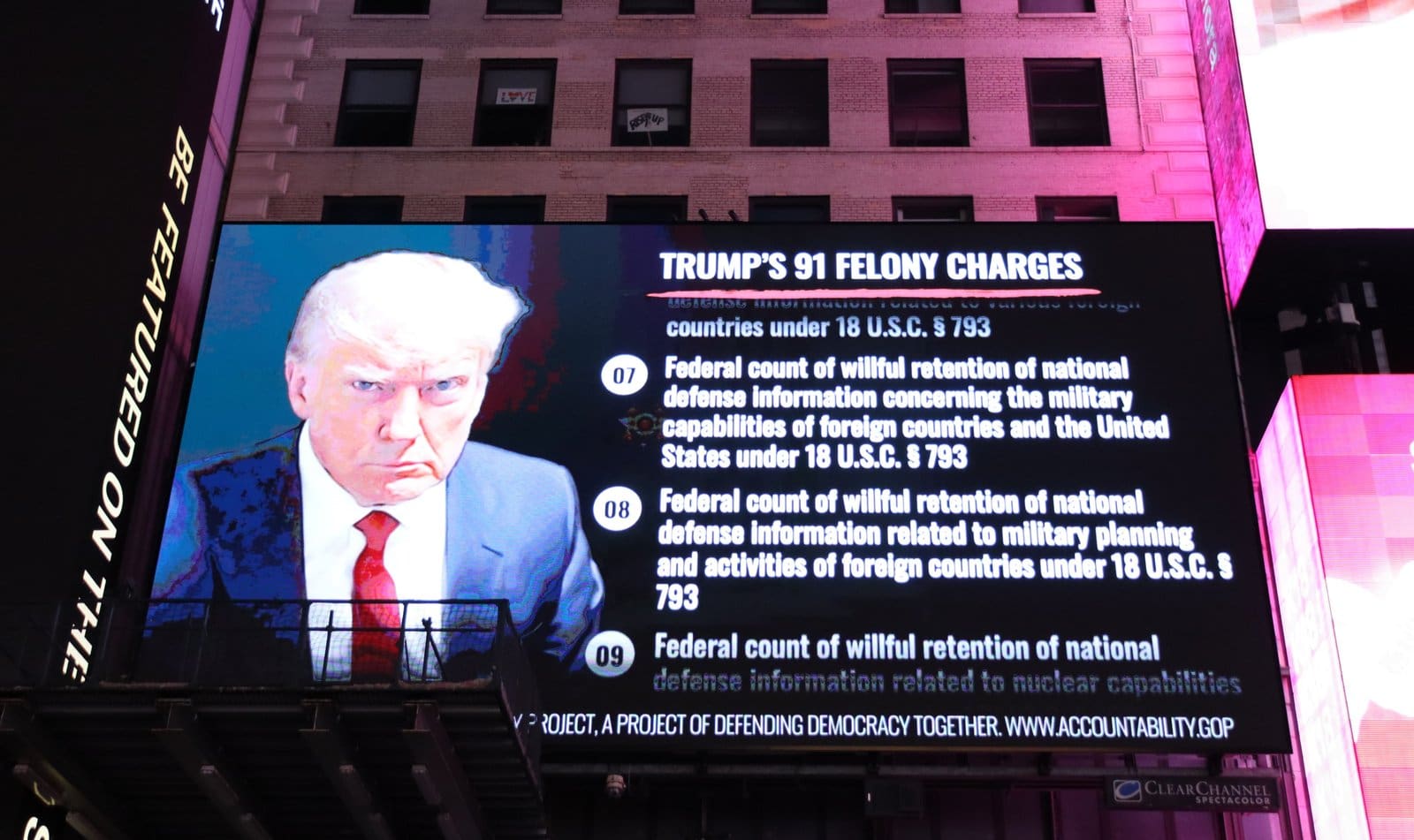
Lawbreaker A billboard in Times Square, New York, scrolling through the list of Trump’s felony charges. It was displayed in September as part of the Republican Accountability Project campaign to highlight Trump’s contempt for the law Pic credit Elvert Barnes Photography
Former President Donald Trump has been indicted for crimes in four different courts, and future trial dates are sure to come during his campaign to be re-elected in 2024. While his core base of supporters holds steady for the time being, it may break away and become the dominant force on the anti‑democratic far right.
At the same time, some Republicans are trying to subvert the impact of Trump’s legal battles, while others are mounting a legal campaign against his presidential re-run.
In New York State, Trump has been indicted on business fraud, for illegally portraying his reimbursement to Michael Cohen, his lawyer, for $130,000 in ‘hush money’ to Stephanie Clifford, known as Stormy Daniels. The cash was supposedly paid to keep quiet the affair she had with Trump. The trial is currently scheduled for 25 March 2024.
In Florida, there is a federal indictment for keeping classified documents at Trump’s Mar-a-Lago Club home. The trial will be held at US district court Fort Pierce, and the trial is currently scheduled for May 2024.
In Georgia, there is a state indictment for election interference in Fulton County. Prosecutors are using the RICO (Racketeer Influenced and Corrupt Organizations Act) conspiracy laws. Eighteen others have been indicted alongside Trump, with two requesting a speedy trail. That may begin this October.
In Washington DC, there is a federal indictment for a scheme to interfere with peaceful transfer of power. There are four counts:
1) Conspiracy to defraud the US
2) Conspiracy to obstruct an official proceeding
3) Obstruction of and attempt to obstruct an official proceeding; and
4) Conspiracy against rights.
This trial, the most important case against Trump, is currently scheduled for 4 March 2024.
The election season officially begins in January 2024 with primaries in Iowa and New Hampshire – and it will conclude with the presidential election in November. Republicans in the House of Representatives have opened an ‘investigation’ of President Biden, hoping to impeach him and quieten the noise about Trump’s trial. Similarly, Georgia’s Attorney General has used the RICO laws to indict more than 60 leftists who protested a planned Atlanta police and fire training complex known by its critics as Cop City.
At the same time, Republicans in Colorado have filed a suit arguing that Trump cannot run for office at all because of a section of the 14th Amendment originally written to prevent Civil War Confederated officers from running for election after that war. And the list of Republican Party officials opposed to Trump begins with former President George W Bush and is growing every day.
Nevertheless, an August 2023 opinion poll showed that Trump and Biden are essentially neck and neck in the presidential election. The many other Republican Party candidates are all polling at least 40 points below Trump. We are still a long way off from the 2024 election, and the polls are more a reflection of Biden’s current weakness.
Nationalist core
The core of Trump’s strength is in the Make America Great Again (MAGA) movement. The slogan was made widely popular by Trump during the 2016 campaign. The movement is often described as ‘populist’, perhaps because of its anti-establishment bearings. In reality, it is nationalist: America first nationalist. It is anti‑immigrant, racist, misogynist, homophobic and sometimes anti‑Semitic. Its origins lie in the Tea Party movement of the Obama Administration years, not in the Republican Party.
The MAGA participants regard themselves as opposed to those they view as ‘elites’ in American society, as well as those they view as beneath them on the social scale: black people and other people of colour. They think that the elites bow to the demands of poor black people and make them pay the price. They feel they are squeezed in the middle.
Unlike conservatives of the Reagan era, they are not afraid of a strong state – if it works for them. Unlike in years past, they now are a self-contained phenomenon, with their own news sources, websites and think-tanks. With control of the Republican Party now in its hands, MAGA adherents have institutional power. While Reagan-era conservatives still have the ability to limit their growth, there is no readily available social bloc to break MAGA up.
The looming trials may wash Trump out of American life, but the MAGA movement is likely to remain in place. In the end, it is more likely than Trump himself to damage and deter motion towards democracy and equality.
Leonard Zeskind is the founder of the Institute for Research and Education of Human Rights, www.IREHR.org
This article first appeared in the Autumn 2023 issue of Searchlight magazine


